
This important article on National Park access was published over the weekend by John Ferguson, Victorian Editor, The Australian. Please consider taking out a subscription to The Australian to see these stories as they are published and to support this journalism.
Grampians climbers were vilified four years ago and many people cheered. Now the lockout problem has gone mainstream, affecting hikers, photographers, bird watchers and nature lovers all around Australia.
What started with Ayers Rock, The Sea Lake Mallee Rally, Mount Warning and Grampians rock climbing, has now reached a point where everyone’s access to National Parks is under threat. Park Authorities are pushing for a friendly-sounding mechanism, known as “joint management”.
Don’t get too wrapped up in Left/Right loyalties. This handback strategy was launched during the NSW Liberals term of office.
The NSW Government recognises that land title is central to the development of a new model for Aboriginal joint management. Accordingly, it is anticipated the new model will provide for the potential handback of title to all NSW national parks – covering nearly 10% of the State – over a 15 to 20-year period, subject to the land being leased back (long term and for nominal rent) to the NSW Government for its continued use and management as national park.
NSW Department of Planning and Environment
The story in The Weekend Australian:
Land access battles wedge users between a rock and a hard place
Officialdom takes a heavy-handed approach to reconcile recreation and Indigenous cultural heritage.
- 2:00AM OCTOBER 28, 2023
- 154 COMMENTS

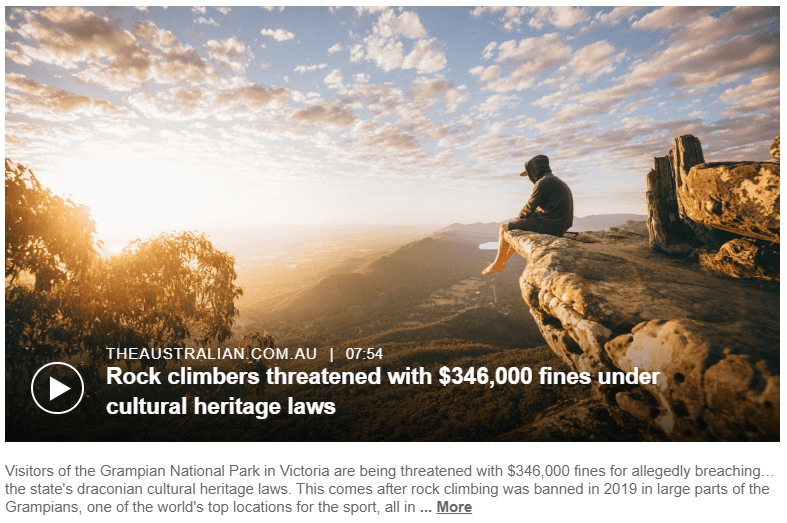
Almost four years to the day after climbing was banned at Uluru on a day of baking heat and mixed emotions, Victoria’s First Peoples – State Relations unit exposed the next leap forward in the national debate over land access.
This month the unit inadvertently detailed in private correspondence the Victorian government’s steps to control the way recreation, traditional owner cultural heritage and the environment intersect by threatening crippling fines against a lone rock climber.
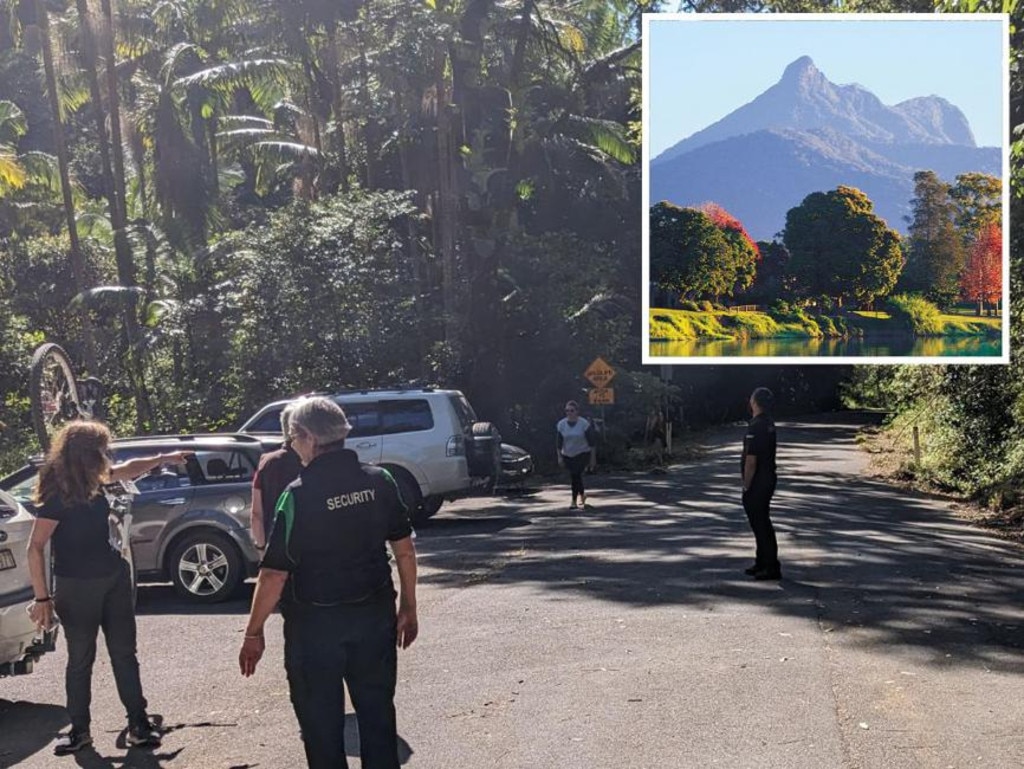
For years, the rock climbing community has known that government agencies have been quietly policing the back roads of the Grampians National Park, 2000km south of Uluru as the crow flies, in a bid to intimidate and scrutinise anyone who might flout bans on movement and recreation under Parks Victoria’s relatively new management plan.
The Grampians management plan, which was prepared in unison with the three local Indigenous groups, restricts activities including hiking, climbing, horse riding, wild camping, the lighting of fires, mountain-biking and even swimming at a popular waterfall, about 250km northwest of Melbourne.
The story that is unfolding at the Grampians – particularly around climbing – is being replicated in NSW and potentially Queensland as governments awaken to the legislative imperatives of taking seriously the concerns of traditional owners.
The Indigenous connection to the Grampians is undisputed and includes ties through rock art, quarrying, artefacts and dreamtime stories, all real and relevant to the future and the past, just as is the desire of others to enter the wilderness in a responsible way but without a bureaucratic noose around their necks.
The question is how Australian governments – Labor and Coalition – come to a conclusion that is true to modern-day beliefs and demands for broad access to publicly owned land while respecting First Nations history.
The desire among traditional owners to protect cultural heritage has been heightened by Rio Tinto’s destruction of the Juukan Gorge rock shelters in Western Australia’s Pilbara and comes as the Albanese government backs a cultural policy to protect tangible and intangible First Nations knowledge and culture.
“I think everybody is now affected by this,” says Australian Climbing Association Victoria president Mike Tomkins, who warns the clamp on activity at the Grampians is so extreme that it affects anyone who wants to use the park outside its most commercial activities in or near the two main towns.
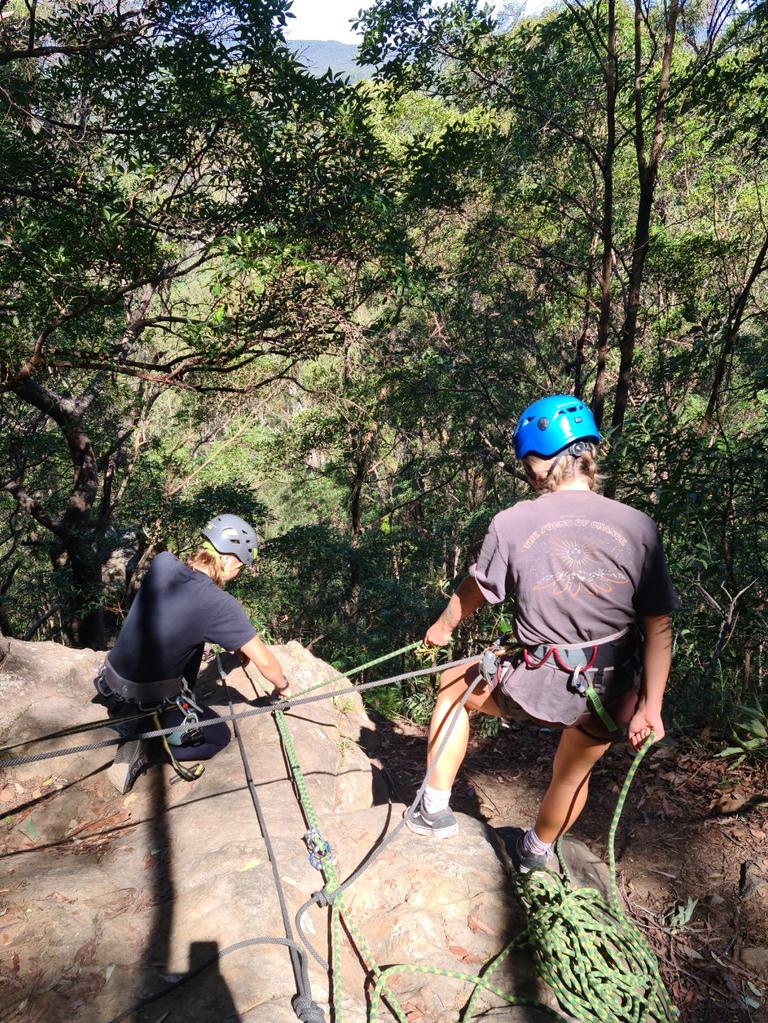
Tomkins is a committed environmentalist who has used a loud hailer to oppose climbing bans at the Grampians, which until 2019 were one of the world’s great climbing destinations. The bans have split climbers into two groups – those such as Tomkins who believe in strident opposition and others who are going more quietly, adopting a conciliatory strategy of engaging with traditional owners over pre-2019 access to climbing areas.
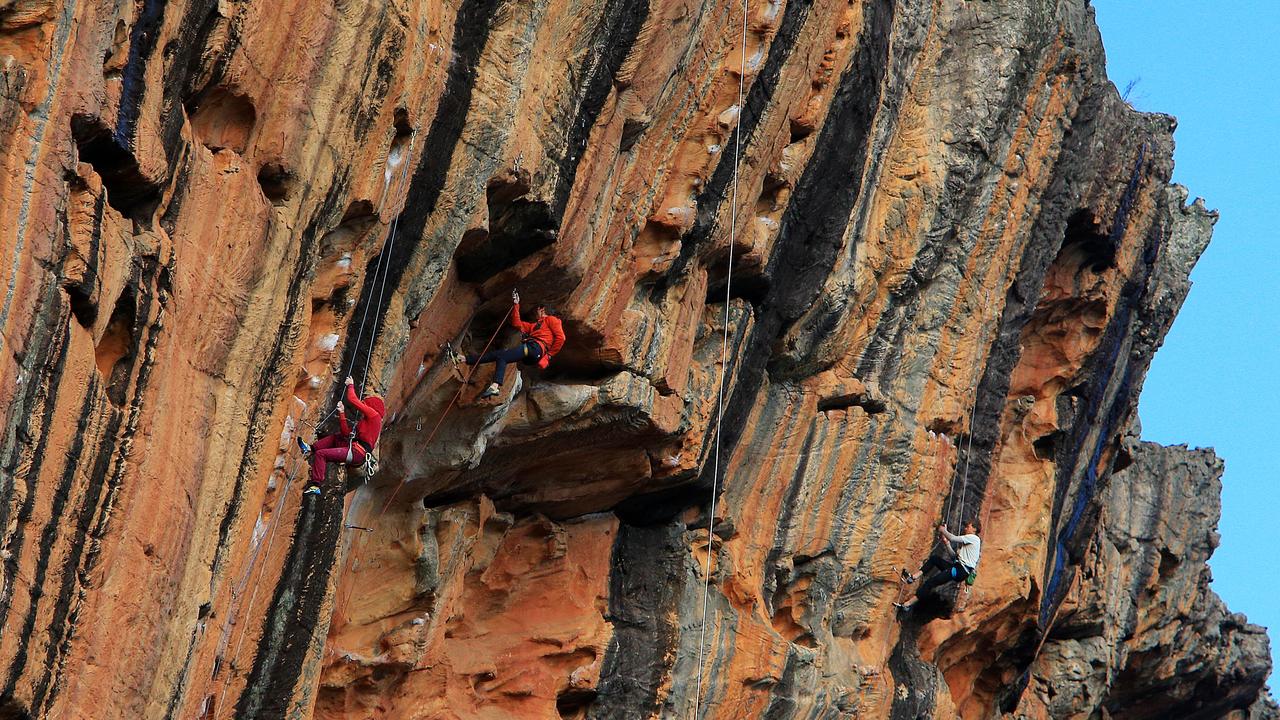
The bans have slashed to the point of gutting a once thriving global industry in the park but recent concessions have been made in key areas that promise conditional – but limited – access.
In Queensland, climbers are fearing the worst in the Glass House Mountains, with Mt Beerwah, on the Sunshine Coast hinterland, facing an uncertain access future, while Mt Warning in northern NSW looks all but lost for people interested in climbing to the top.
On Queensland, Save our Summits president Craig Evans warns that if local Indigenous groups force the shutdown of the hiking trail up Mt Beerwah because of cultural sensitivities, it could be lost for good. “We just want to be a voice on the other side of the conversation,” he says. “It’s only increasing resentment. Surely we need to learn from the past.”
While debate is raging in NSW, Queensland and Victoria, the Grampians have emerged as an unlikely national template for what could come.
Restrictions to access go way beyond rock climbing.
Parks Victoria, like so many other key bodies in Victoria, is chaired by a former state Labor minister. In this case it is John Pandazopoulos, a former high-profile member of the Socialist Left faction that now controls Victoria.
On many measures, Parks Victoria has bungled the sale and implementation of the climbing bans, making a series of false, misleading or unsubstantiated accusations about the role of climbers in the degradation of the Grampians, also known as Gariwerd.
Instead of working from the outset with climbers to diminish any environmental or cultural issues, the government hit the sector with a guillotine and now has restricted old-school wilderness access across the park.
While there were areas where climbers could have improved their impact on heritage and the environment, the group as a collective has had a generally positive impact on areas.
Old photos of nearby Mt Arapiles, also known as Dyurrite, show how a degraded landscape that once was used as a firing range and for grazing has been transformed across the decades with the help of climbers.
The net overall effect of the Parks Victoria agenda has been to pile pressure on traditional owners and divide the park’s users, with vocal critics of the policy being opposed by more moderate participants in the debate, who accept that post-Uluru the world has changed.
This week Victorian Premier Jacinta Allan strongly backed the curbs on climbing. Allan said the bans, affecting up to 80 per cent of the best climbing routes, were needed to protect Indigenous cultural sites.
“The natural beauty that attracts so many of us to that beautiful part of the world also needs to be protected and supported and that is why there are certain areas that need to be protected from an environmental perspective or from an Aboriginal cultural heritage perspective,” she said.
The Grampians are split between two federal electorates – Mallee and Wannon – and both voted overwhelmingly against the Indigenous voice in the recent referendum, although this conservatism likely reflects demography as much as geography.
Since 2007 in Victoria, governments have had access to the Aboriginal Heritage Act, which carries penalties of more than $346,000 for individuals (per offence) who damage or interfere with cultural sites or artefacts.
In that time, the legislation has been virtually dormant; there have been six prosecutions under the act since 2007, with penalties imposed by the courts to date resulting in fines paid ranging from $2500 to $35,000.
There are seven full-time enforcement and compliance authorised officers.
Just four days after the voice referendum failed, the act was cited in a threat against a climber.
A compliance and enforcement investigator at Victoria’s First Peoples – State Relations, which works within the Department of Premier and Cabinet, corresponded with a rock climber at the Grampians.
Adam Green warned in a letter to a rock climber whose car was allegedly found in, or near, banned areas in the Grampians that maximum penalties of more than $346,000 existed for people who were found guilty of damaging cultural heritage.
“I am requesting the name of the person in charge of the above vehicle on specific dates in relations to breaches of the Act,” the letter reads.
“The current maximum penalty exceeds $346,000 for an individual found guilty under section 27 of the Act.”
What piqued interest was the fact Green had personally visited the climber’s residence at least twice after a government official, likely from Parks Victoria, had monitored a car in the Grampians.
Green said: “The Act provides for the protection and management of Aboriginal cultural heritage and sets out a regime for regulating activities which may impact upon Aboriginal cultural heritage.”
The decision to threaten the use of the legislation comes despite it rarely having been enforced in the past 16 years, with a Victorian farmer fined $20,000 for knowingly harming Aboriginal cultural heritage in 2017 one of the six prosecutions.
The farmer, Alan James Tweddle, then 75, pleaded guilty in the Seymour Magistrates Court to causing harm to Aboriginal cultural heritage by extracting sand from a quarry on his farm.
Fast forward six years and the government, in the shadow of the referendum, is threatening crippling fines to a climber who may or may not have had any impact at all on cultural heritage.
Asked how many climbers had been charged, Parks Victoria said: “While we don’t release operational details on the number of infringement notices issued, we’ve seen a high level of compliance and respect for the changes to climbing access since they were introduced.
“We’re continuing to work with traditional owners and the Climbing Victoria Advisory Council to review more sites across the national park, building on the good work done at Taipan Wall.
“The Greater Gariwerd Landscape Management Plan sets aside more than 100 areas for climbing and commits to working with climbers and the community to review many more.’’
Under the previous management plan, Parks Victoria had actually collaborated with climbers, helping them to access routes and encourage the pursuit that was so valued globally because of the nature of the rock and the accessibility that people such as Oscar-winning free solo climber Alex Honnold travelled to the Grampians to try. Honnold is considered arguably the greatest climber of all; he has supported the climbers’ campaign.
There is no question that the pursuit of climbing led to some damage to rock and vegetation, including through the use of chalk (which can wash off) and bolting, which is mostly hard to see and dwarfed in impact compared with infrastructure such as communications towers and guard rails.
The relationship between many climbers and Parks Victoria collapsed when some of the key claims against climbers proved to be false or unverifiable, including over the alleged extent of damage, wrong claims of a bolt in rock art and unsubstantiated (and unlikely) allegations of climber-driven graffiti.
Famously, it was revealed that government workers had in fact bolted rock art and Parks Victoria was accused of mistaking bird manure and naturally occurring rock stains for artificial chalk used to assist climbing ascents.
Meanwhile, across the park in areas visited by mainstream tourists, graffiti was ubiquitous and environmental harm common, an increasingly common trend as people disconnected from the values of wilderness show a lack of respect for the outdoors.
The management plan that led to the current crisis was prepared by Parks Victoria, Barengi Gadjin Land Council Aboriginal Corporation, Eastern Maar Aboriginal Corporation, and Gunditj Mirring Traditional Owners Aboriginal Corporation.
BGLC said media communications were being handled by Parks Victoria; Eastern Maar did not respond.
BGLC manager of on country operations Stuart Harradine said at the time of the management plan launch that connection to the area was hard to explain.
“It’s what you might call a living cultural landscape. So it’s environmental, cultural, spiritual,” he said.
“It’s a lot of things to myself and other traditional owners. It’s often hard to express to non-Aboriginal people in a full sense.”
Local ranger Jake Goodes – the brother of AFL great Adam Goodes – said he was gutted to see chalk remnants, bolts and vegetation damage caused by climbing.
Little has been said by Parks Victoria about the worst-affected graffiti areas that have included the tourist walk to the Pinnacle high above Halls Gap in the run-up to the Covid-19 shutdowns.
This has only inflamed Tomkins and others, who see the trend towards shutting out honest adventurers as an unfair slight that is likely to widen as cultural heritage laws are prosecuted more vigorously across Australia.
********************************************************************************************
Rock climbing is successfully managed internationally, using collaborative management methods, as described within the Victorian Climbing Management Guidelines.
You are invited to join our Facebook discussion group: ACAV Access Discussion
ACAV is currently seeking a webmaster to upgrade our membership and payment system. If you can help, please contact: acav@climb.org.au
 Australian Climbing Association (Vic) Inc.