All Park Users Face Lockouts and Huge Fines

This important article on National Park access was published over the weekend by John Ferguson, Victorian Editor, The Australian. Please consider taking out a subscription to The Australian to see these stories as they are published and to support this journalism.
Grampians climbers were vilified four years ago and many people cheered. Now the lockout problem has gone mainstream, affecting hikers, photographers, bird watchers and nature lovers all around Australia.

What started with Ayers Rock, The Sea Lake Mallee Rally, Mount Warning and Grampians rock climbing, has now reached a point where everyone’s access to National Parks is under threat. Park Authorities are pushing for a friendly-sounding mechanism, known as “joint management”.

Don’t get too wrapped up in Left/Right loyalties. This handback strategy was launched during the NSW Liberals term of office.

The NSW Government recognises that land title is central to the development of a new model for Aboriginal joint management. Accordingly, it is anticipated the new model will provide for the potential handback of title to all NSW national parks – covering nearly 10% of the State – over a 15 to 20-year period, subject to the land being leased back (long term and for nominal rent) to the NSW Government for its continued use and management as national park.

NSW Department of Planning and Environment

The story in The Weekend Australian:

Land access battles wedge users between a rock and a hard place

Officialdom takes a heavy-handed approach to reconcile recreation and Indigenous cultural heritage.

Almost four years to the day after climbing was banned at Uluru on a day of baking heat and mixed emotions, Victoria’s First Peoples – State Relations unit exposed the next leap forward in the national debate over land access.

This month the unit inadvertently detailed in private correspondence the Victorian government’s steps to control the way recreation, traditional owner cultural heritage and the environment intersect by threatening crippling fines against a lone rock climber.

For years, the rock climbing community has known that government agencies have been quietly policing the back roads of the Grampians National Park, 2000km south of Uluru as the crow flies, in a bid to intimidate and scrutinise anyone who might flout bans on movement and recreation under Parks Victoria’s relatively new management plan.

The Grampians management plan, which was prepared in unison with the three local Indigenous groups, restricts activities including hiking, climbing, horse riding, wild camping, the lighting of fires, mountain-biking and even swimming at a popular waterfall, about 250km northwest of Melbourne.

The story that is unfolding at the Grampians – particularly around climbing – is being replicated in NSW and potentially Queensland as governments awaken to the legislative imperatives of taking seriously the concerns of traditional owners.

The Indigenous connection to the Grampians is undisputed and includes ties through rock art, quarrying, artefacts and dreamtime stories, all real and relevant to the future and the past, just as is the desire of others to enter the wilderness in a responsible way but without a bureaucratic noose around their necks.
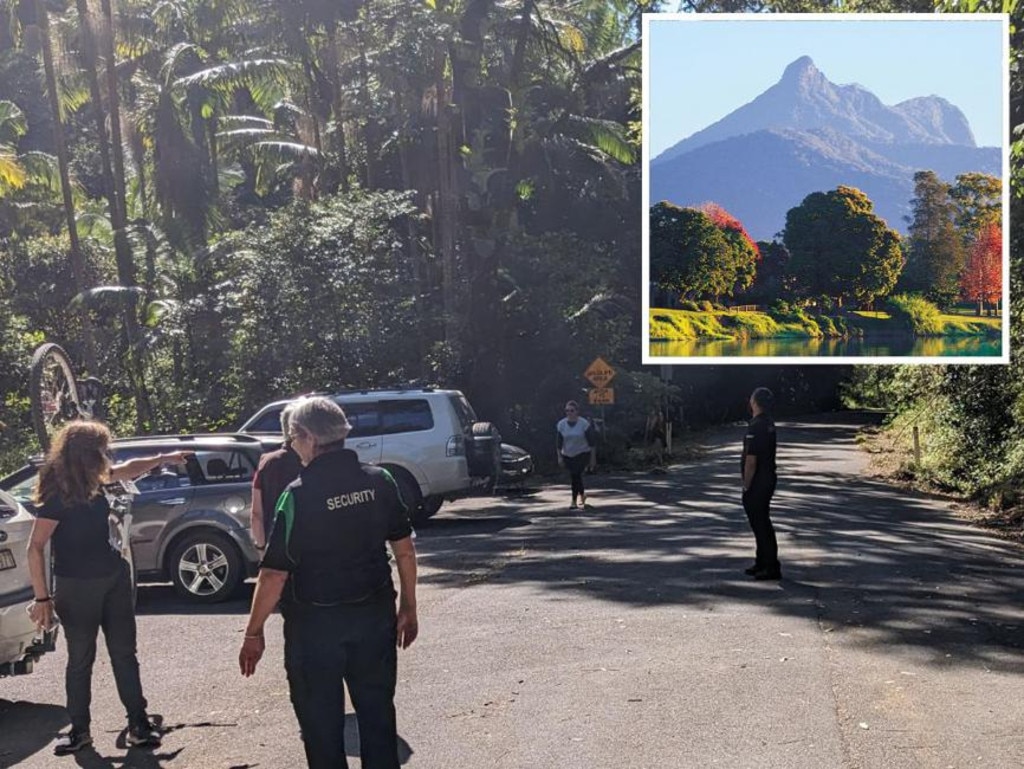
Security guards stopping walkers from going up Mount Warning.

The question is how Australian governments – Labor and Coalition – come to a conclusion that is true to modern-day beliefs and demands for broad access to publicly owned land while respecting First Nations history.

The desire among traditional owners to protect cultural heritage has been heightened by Rio Tinto’s destruction of the Juukan Gorge rock shelters in Western Australia’s Pilbara and comes as the Albanese government backs a cultural policy to protect tangible and intangible First Nations knowledge and culture.

“I think everybody is now affected by this,” says Australian Climbing Association Victoria president Mike Tomkins, who warns the clamp on activity at the Grampians is so extreme that it affects anyone who wants to use the park outside its most commercial activities in or near the two main towns.

Tomkins is a committed environmentalist who has used a loud hailer to oppose climbing bans at the Grampians, which until 2019 were one of the world’s great climbing destinations. The bans have split climbers into two groups – those such as Tomkins who believe in strident opposition and others who are going more quietly, adopting a conciliatory strategy of engaging with traditional owners over pre-2019 access to climbing areas.

The bans have slashed to the point of gutting a once thriving global industry in the park but recent concessions have been made in key areas that promise conditional – but limited – access.

In Queensland, climbers are fearing the worst in the Glass House Mountains, with Mt Beerwah, on the Sunshine Coast hinterland, facing an uncertain access future, while Mt Warning in northern NSW looks all but lost for people interested in climbing to the top.

On Queensland, Save our Summits president Craig Evans warns that if local Indigenous groups force the shutdown of the hiking trail up Mt Beerwah because of cultural sensitivities, it could be lost for good. “We just want to be a voice on the other side of the conversation,” he says. “It’s only increasing resentment. Surely we need to learn from the past.”

While debate is raging in NSW, Queensland and Victoria, the Grampians have emerged as an unlikely national template for what could come.

Restrictions to access go way beyond rock climbing.
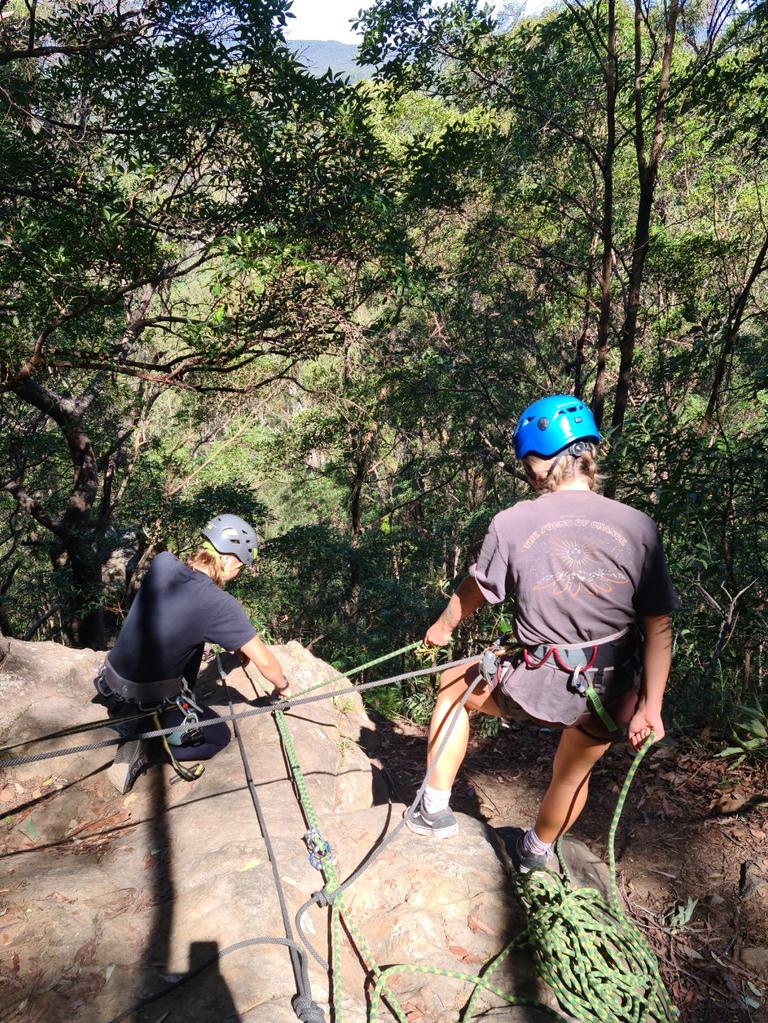
Climbers fear the worst in Queensland’s Glass House Mountains, with Mt Beerwah facing an uncertain access future.

Parks Victoria, like so many other key bodies in Victoria, is chaired by a former state Labor minister. In this case it is John Pandazopoulos, a former high-profile member of the Socialist Left faction that now controls Victoria.

On many measures, Parks Victoria has bungled the sale and implementation of the climbing bans, making a series of false, misleading or unsubstantiated accusations about the role of climbers in the degradation of the Grampians, also known as Gariwerd.

Instead of working from the outset with climbers to diminish any environmental or cultural issues, the government hit the sector with a guillotine and now has restricted old-school wilderness access across the park.

While there were areas where climbers could have improved their impact on heritage and the environment, the group as a collective has had a generally positive impact on areas.

Old photos of nearby Mt Arapiles, also known as Dyurrite, show how a degraded landscape that once was used as a firing range and for grazing has been transformed across the decades with the help of climbers.

The net overall effect of the Parks Victoria agenda has been to pile pressure on traditional owners and divide the park’s users, with vocal critics of the policy being opposed by more moderate participants in the debate, who accept that post-Uluru the world has changed.

This week Victorian Premier Jacinta Allan strongly backed the curbs on climbing. Allan said the bans, affecting up to 80 per cent of the best climbing routes, were needed to protect Indigenous cultural sites.

“The natural beauty that attracts so many of us to that beautiful part of the world also needs to be protected and supported and that is why there are certain areas that need to be protected from an environmental perspective or from an Aboriginal cultural heritage perspective,” she said.

The Grampians are split between two federal electorates – Mallee and Wannon – and both voted overwhelmingly against the Indigenous voice in the recent referendum, although this conservatism likely reflects demography as much as geography.

Since 2007 in Victoria, governments have had access to the Aboriginal Heritage Act, which carries penalties of more than $346,000 for individuals (per offence) who damage or interfere with cultural sites or artefacts.

In that time, the legislation has been virtually dormant; there have been six prosecutions under the act since 2007, with penalties imposed by the courts to date resulting in fines paid ranging from $2500 to $35,000.

There are seven full-time enforcement and compliance authorised officers.

Just four days after the voice referendum failed, the act was cited in a threat against a climber.

A compliance and enforcement investigator at Victoria’s First Peoples – State Relations, which works within the Department of Premier and Cabinet, corresponded with a rock climber at the Grampians.

Adam Green warned in a letter to a rock climber whose car was allegedly found in, or near, banned areas in the Grampians that maximum penalties of more than $346,000 existed for people who were found guilty of damaging cultural heritage.

“I am requesting the name of the person in charge of the above vehicle on specific dates in relations to breaches of the Act,” the letter reads.

“The current maximum penalty exceeds $346,000 for an individual found guilty under section 27 of the Act.”

What piqued interest was the fact Green had personally visited the climber’s residence at least twice after a government official, likely from Parks Victoria, had monitored a car in the Grampians.

Green said: “The Act provides for the protection and management of Aboriginal cultural heritage and sets out a regime for regulating activities which may impact upon Aboriginal cultural heritage.”

The decision to threaten the use of the legislation comes despite it rarely having been enforced in the past 16 years, with a Victorian farmer fined $20,000 for knowingly harming Aboriginal cultural heritage in 2017 one of the six prosecutions.

The farmer, Alan James Tweddle, then 75, pleaded guilty in the Seymour Magistrates Court to causing harm to Aboriginal cultural heritage by extracting sand from a quarry on his farm.

Fast forward six years and the government, in the shadow of the referendum, is threatening crippling fines to a climber who may or may not have had any impact at all on cultural heritage.

Asked how many climbers had been charged, Parks Victoria said: “While we don’t release operational details on the number of infringement notices issued, we’ve seen a high level of compliance and respect for the changes to climbing access since they were introduced.

“We’re continuing to work with traditional owners and the Climbing Victoria Advisory Council to review more sites across the national park, building on the good work done at Taipan Wall.

“The Greater Gariwerd Landscape Management Plan sets aside more than 100 areas for climbing and commits to working with climbers and the community to review many more.’’

Under the previous management plan, Parks Victoria had actually collaborated with climbers, helping them to access routes and encourage the pursuit that was so valued globally because of the nature of the rock and the accessibility that people such as Oscar-winning free solo climber Alex Honnold travelled to the Grampians to try. Honnold is considered arguably the greatest climber of all; he has supported the climbers’ campaign.

There is no question that the pursuit of climbing led to some damage to rock and vegetation, including through the use of chalk (which can wash off) and bolting, which is mostly hard to see and dwarfed in impact compared with infrastructure such as communications towers and guard rails.

The relationship between many climbers and Parks Victoria collapsed when some of the key claims against climbers proved to be false or unverifiable, including over the alleged extent of damage, wrong claims of a bolt in rock art and unsubstantiated ­(and unlikely) allegations of climber-driven graffiti.

Famously, it was revealed that government workers had in fact bolted rock art and Parks Victoria was accused of mistaking bird manure and naturally occurring rock stains for ­artificial chalk used to assist climbing ascents.

Meanwhile, across the park in areas visited by mainstream tourists, graffiti was ubiquitous and environmental harm common, an increasingly common trend as people disconnected from the values of wilderness show a lack of respect for the outdoors.

The management plan that led to the current crisis was prepared by Parks Victoria, Barengi Gadjin Land Council Aboriginal Corporation, Eastern Maar Aboriginal Corporation, and Gunditj Mirring Traditional Owners Aboriginal Corporation. 

BGLC said media communications were being handled by Parks Victoria; Eastern Maar did not respond.

BGLC manager of on country operations Stuart Harradine said at the time of the management plan launch that connection to the area was hard to explain.

“It’s what you might call a living cultural landscape. So it’s environmental, cultural, spiritual,” he said.

“It’s a lot of things to myself and other traditional owners. It’s often hard to express to non-Aboriginal people in a full sense.”

Local ranger Jake Goodes – the brother of AFL great Adam Goodes – said he was gutted to see chalk remnants, bolts and vegetation damage caused by climbing.

Little has been said by Parks Victoria about the worst-affected graffiti areas that have included the tourist walk to the Pinnacle high above Halls Gap in the run-up to the Covid-19 shutdowns.

This has only inflamed Tomkins and others, who see the trend towards shutting out honest adventurers as an unfair slight that is likely to widen as cultural heritage laws are prosecuted more vigorously across Australia.

********************************************************************************************

Rock climbing is successfully managed internationally, using collaborative management methods, as described within the Victorian Climbing Management Guidelines.

You are invited to join our Facebook discussion group: ACAV Access Discussion

ACAV is currently seeking a webmaster to upgrade our membership and payment system. If you can help, please contact: acav@climb.org.au
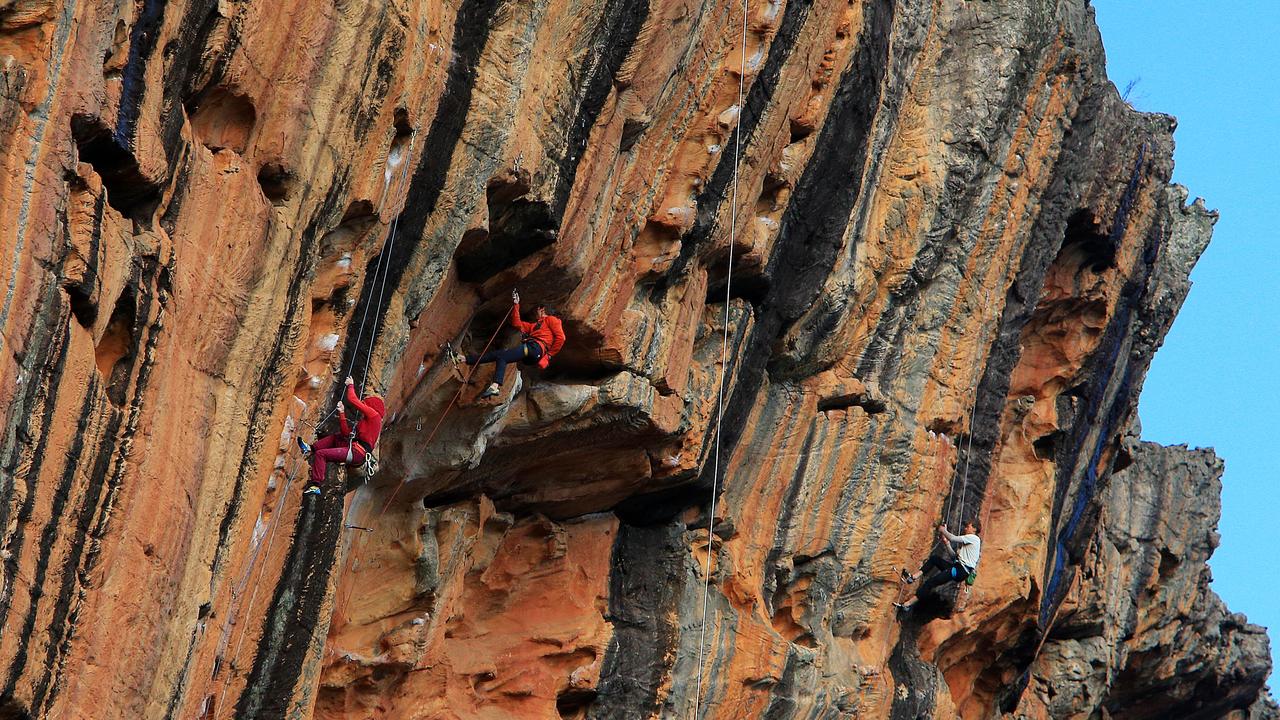
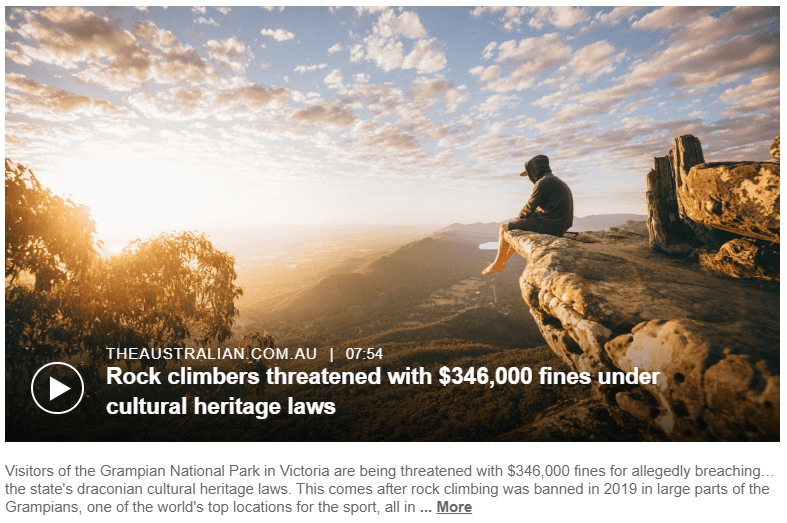
Can I really be fined $346,000 for visiting the wrong part of the Grampians?

This is what the Australian newspaper had to say about this on 27th October 2023:

(please consider taking out a subscription to The Australian to see these stories as they are published)

******************************************************************************

Victoria’s culture crackdown grabs six since 2007

Rock climbing enthusiasts in the Grampians, where much of the best climbing routes have been banned due to cultural heritage reasons. Picture: Aaron Francis

There have been just six prosecutions since 2007 under Victoria’s controversial cultural heritage laws that are being used to threaten rock climbers with huge fines.

As debate rages over a rock climber being threatened with fines of more than $346,000, the Allan government has revealed the Aboriginal Heritage Act has been used only sparingly since it was first ratified by the parliament in 2007.

The highest profile case was in 2017 when an elderly farmer pleaded guilty in the Seymour Magistrates Court to causing harm to Aboriginal cultural heritage by extracting sand from a quarry on his farm.

Other fines and prosecutions include a 2010 fine of $2500 for an offender who was found guilty of offering Aboriginal objects for sale, a person pleaded guilty in 2013 to unlawful possession of ancestral remains, a person hindered an investigator in 2017 and was given a 12-month good behaviour bond and, in the same year, a person pleaded guilty to harming heritage and was fined $7500 without conviction.

The government said the six cases had resulted in court-imposed penalties of between $2500 and $35,000, well below the maximum current-day fines for an individual of more than $346,000.

The Australian revealed this week that a climber had been visited twice at their property by a First Nations-State Relations investigator who wanted to question them after their car was spotted in the Grampians National Park, where much of the best climbing routes have been banned due to cultural heritage reasons.

READ MORE: Culture clash | Huge fines and new tactics used to ensure Aboriginal cultural heritage laws followed

The bans came after First ­Nations people at Uluru forced the close of climbing on the rock due to spiritual concerns but also mistreatment of the area.

There are seven full-time enforcement and compliance authorised officers within an agency inside Victoria’s Department of Premier and Cabinet charged with investigating and monitoring compliance under the legislation and to enforce protection measures when necessary. They do not have the power to issue fines; these powers are held by the courts.

The Australian revealed this week that the Victorian Aboriginal Heritage Council warned in a pre-election legislative review that staff investigating alleged cultural heritage breaches had too little power to properly determine what has happened.

The council said in 2021 the law should be toughened so that officers can enter land or premises without the consent of the occupier, which would also mean ­investigators could walk on to farms or other land if the owner was away. The government has noted the request but is not pushing ahead with the recommendation.

There is a push among some First Nations leaders to more aggressively protect cultural heritage.

National Farmers Federation president David Jochinke. Picture: NCA NewsWire/Martin Ollman

The government has spent the past four years targeting rock climbers in Victoria’s Grampians National Park but has become embroiled in controversy after Parks Victoria made a series of errors and unsubstantiated claims building the case for large scale shutdowns of climbing. It has reintroduced climbing in key parts of the park but, overall, dramatically scaled back the pursuit at what many believe to be one of the world’s best theatres for climbing.

The question of protecting heritage on private land has alarmed farmers, given that cultural heritage is ubiquitous across Australia.

National Farmers Federation president David Jochinke said farmers wanted to protect cultural heritage but said there was confusion and ambiguity about rules at a state level.

“We hope other states considering similar legislation learn from the WA fallout and avoid ­repeating the same mistakes. We know the federal government is looking at reforming its laws to protect cultural heritage,’’ he said. “We wouldn’t want these changes to overlap with what’s being done at a state level. Instead, we’d like to see the commonwealth achieve some level of harmonisation.”

******************************************************************************

Rock climbing is successfully managed internationally, using collaborative management methods, as described within the Victorian Climbing Management Guidelines.

You are invited to join our Facebook discussion group: ACAV Access Discussion

ACAV is currently seeking a webmaster to upgrade our membership and payment system. If you can help, please contact: acav@climb.org.au
Millennium Cave, Grampians, Reparation Proposal: The Government Position.

Parks Victoria intends to carry out rock reparation works under advice from First Peoples State Relations (formerly known as Aboriginal Victoria, sitting within the Department of Premier & Cabinet).

ACAV has raised concerns with FPSR as a duty of care, that any proposed reparation works using safe workplace practices, are likely to cause significant harm to the site.

Matthew Lloyd of FPSR has personally assured ACAV that a permit has been acquired and consequently, harm will be minimised.

FPSR letter to ACAV

The degree of acceptable harm remains unknown. We are not sure who, within the decision-making chain has visited the site and reviewed a work method statement. It remains likely that practical workplace challenges remain unresolved.

ACAV will continue to monitor and escalate accordingly. Our members remain concerned.

Grampians Millennium Cave Project Postponed After Community Concerns

A Parks Victoria project to remove climbing bolts from Millennium Cave in the Grampians has been halted at the eleventh hour.

Without getting too much into the whys and wherefores of the project, this article seeks to explore practical issues and provide background commentary for those interested in this story and who may have never visited these caves.

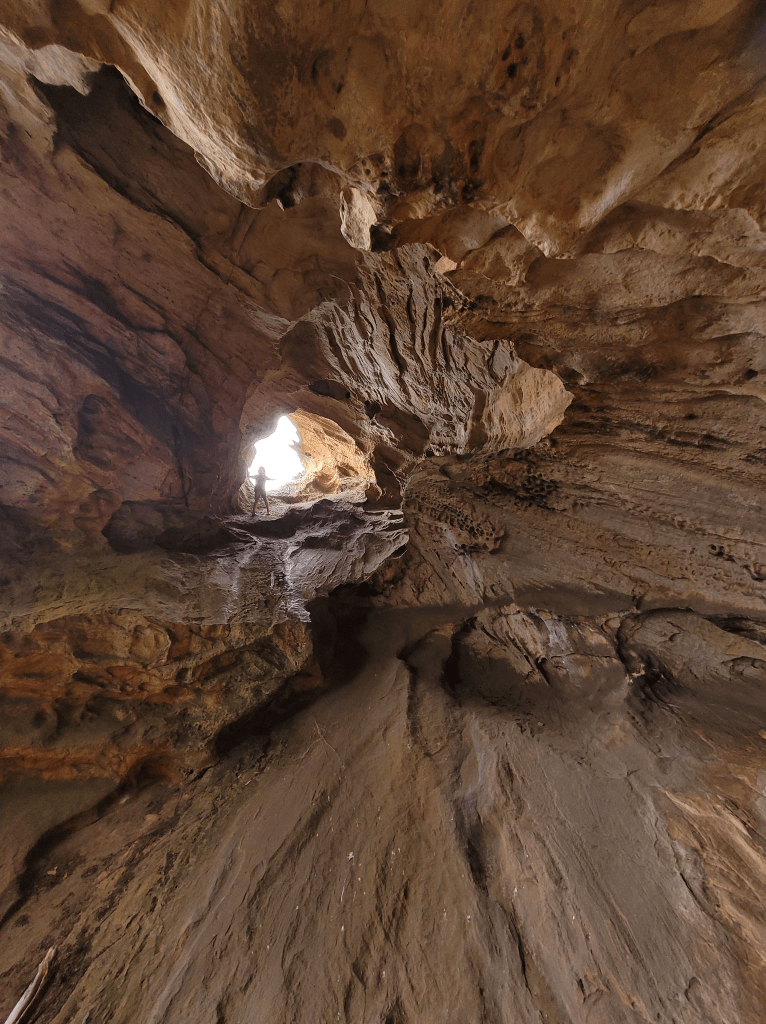
If you haven’t been to Millennium Caves, please take a look at the photos and scroll down to read more about this latest episode in the Grampians climbing access story. These caves have recently been placed off-limits to everyone. If you want to “see” this amazing place, details can be found below, along with some inspiring photographs.

Millennium Caves: The Crag Online Guide

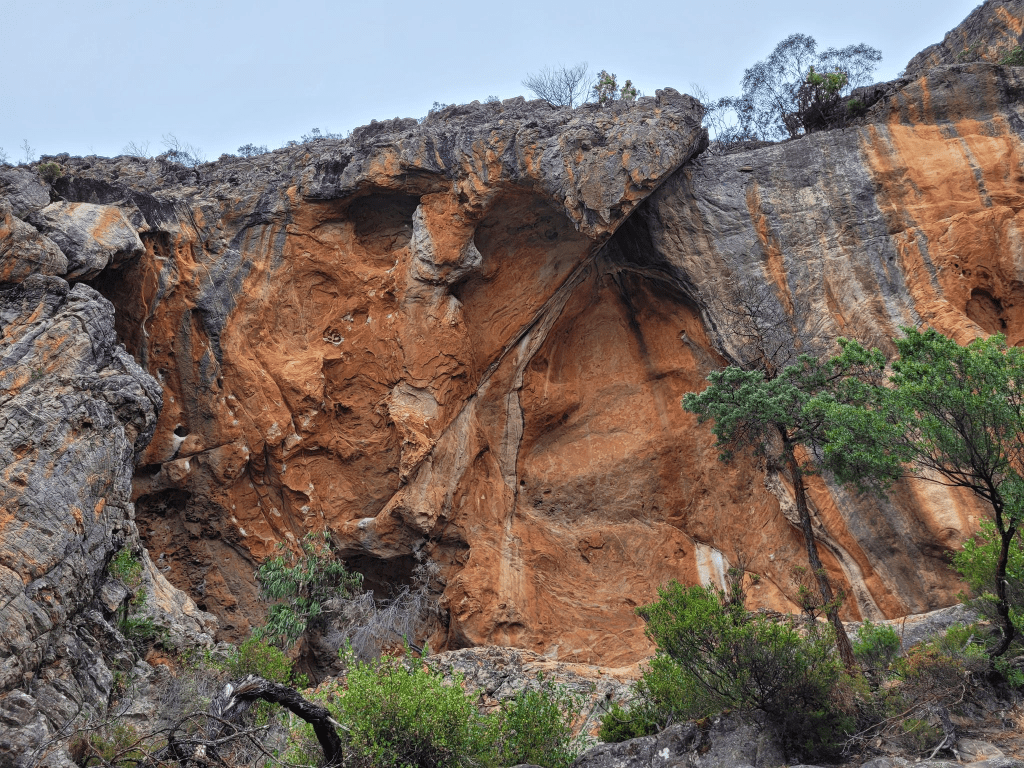
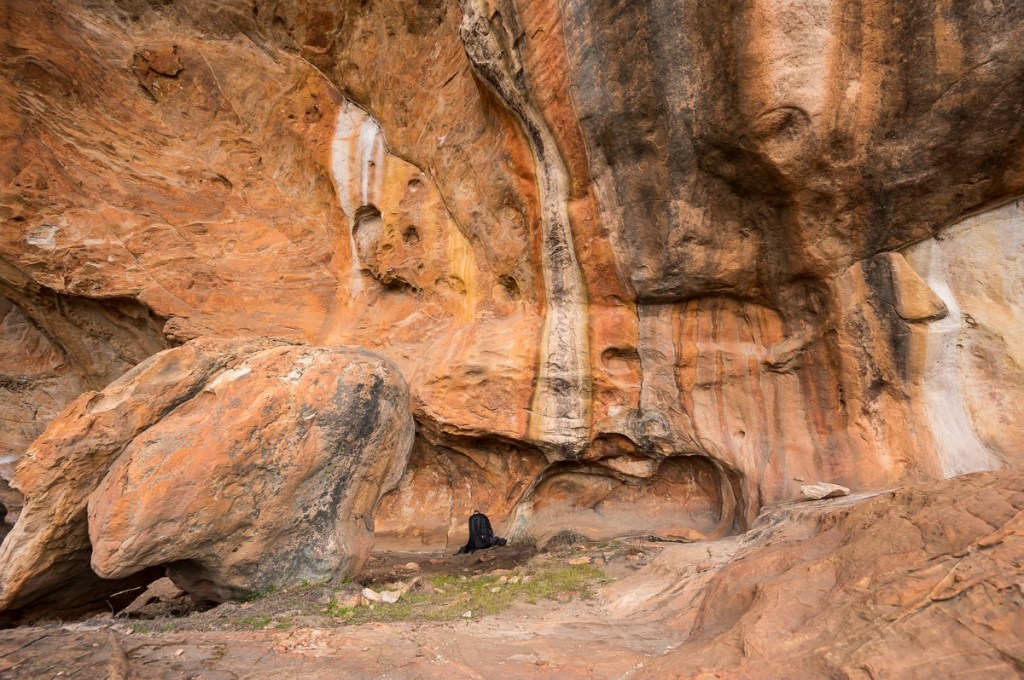
The lower Millennium cave, tier 1 – The proposed work site
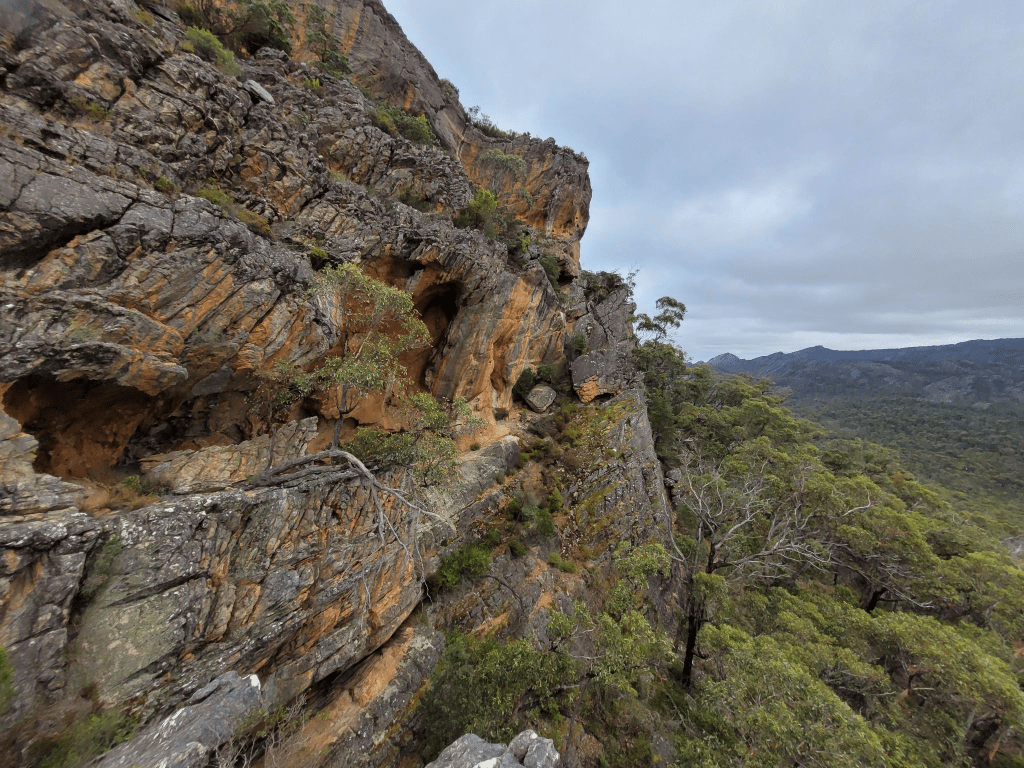
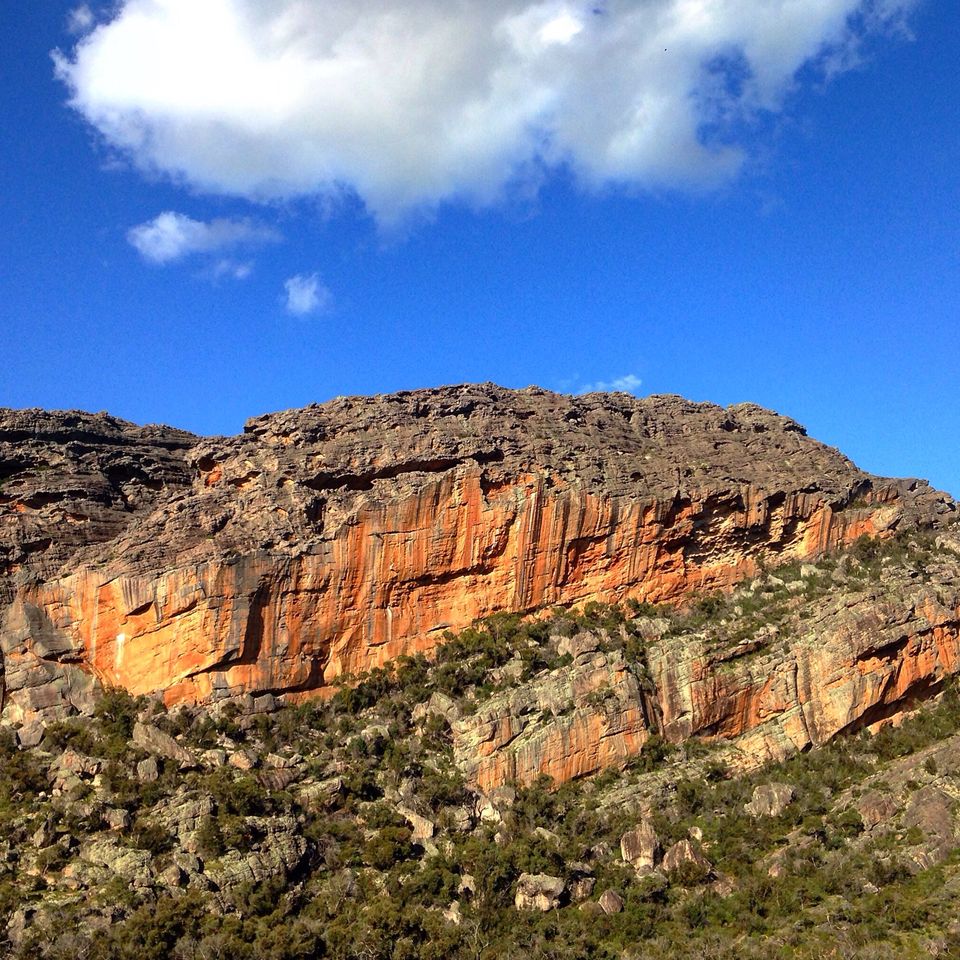
Millennium Cave tier 1 is in the middle of this photo – access route for contractors’ equipment would be up a sloping rocky ramp from the dense bushland below
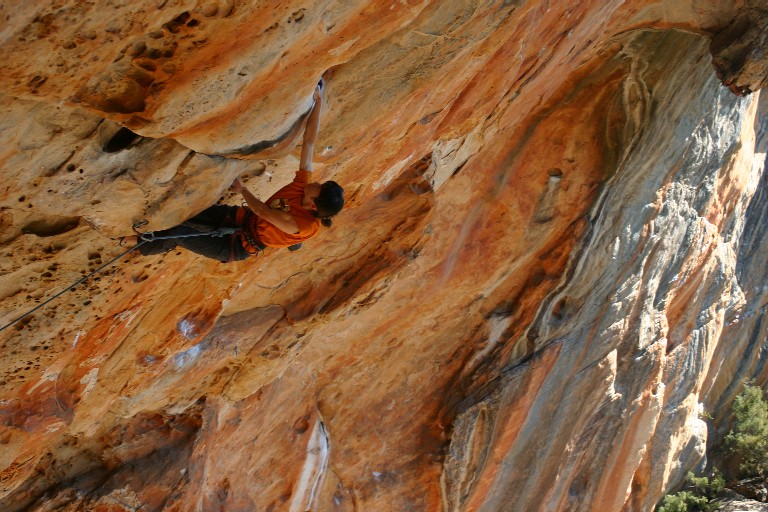
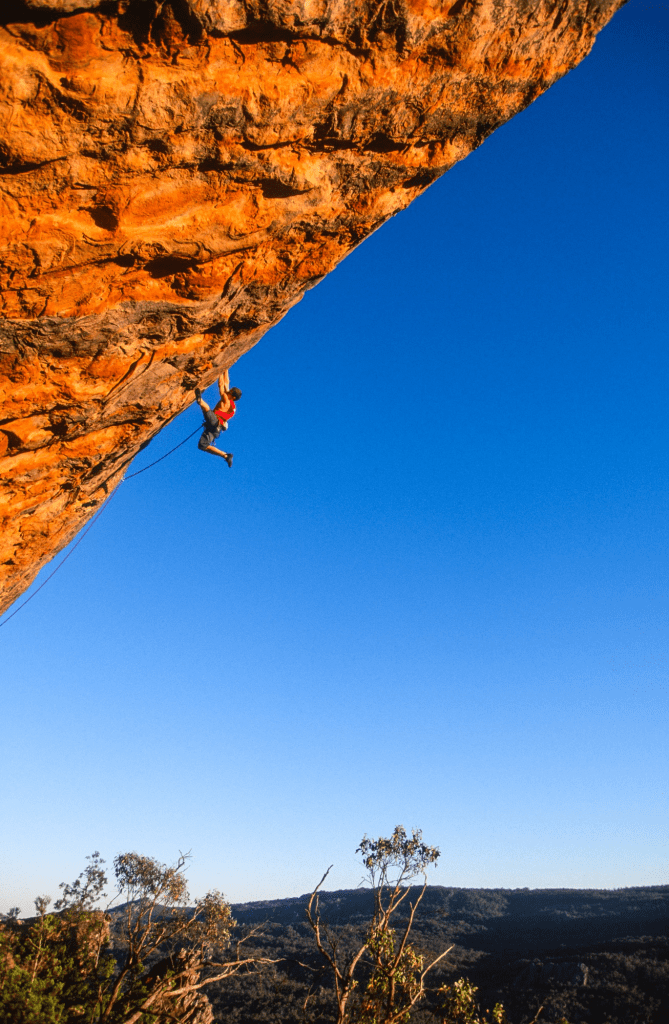
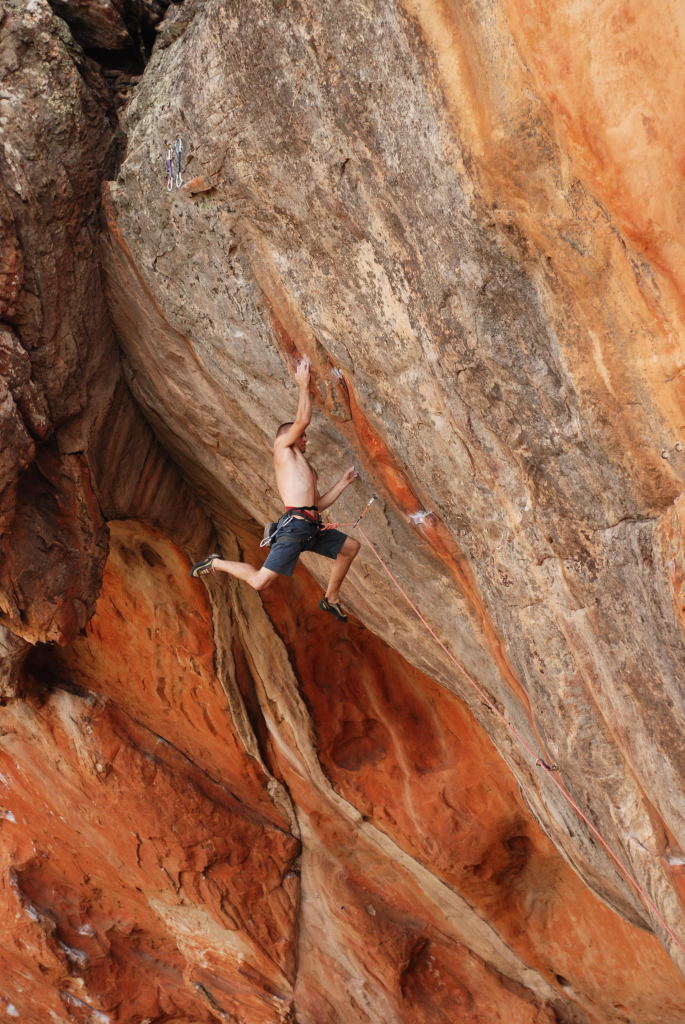
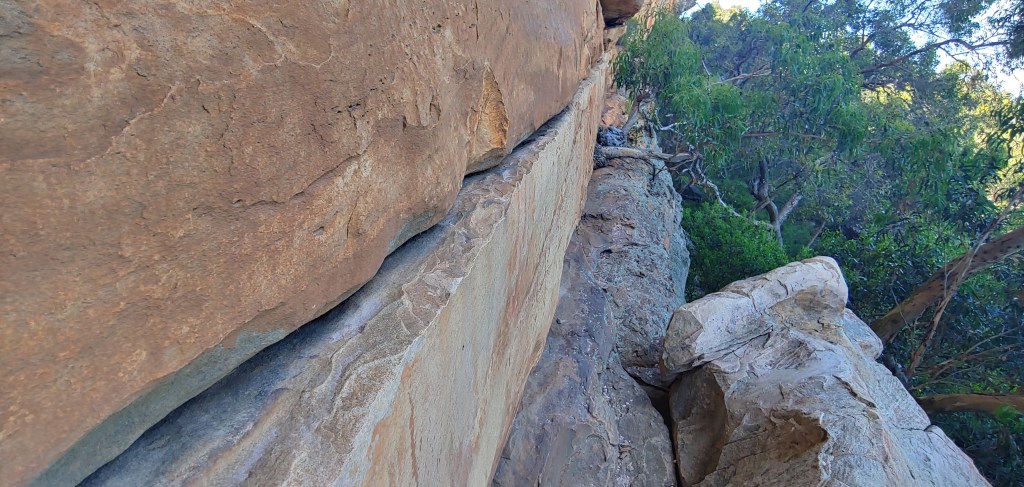
The cave surfaces are incredibly steep

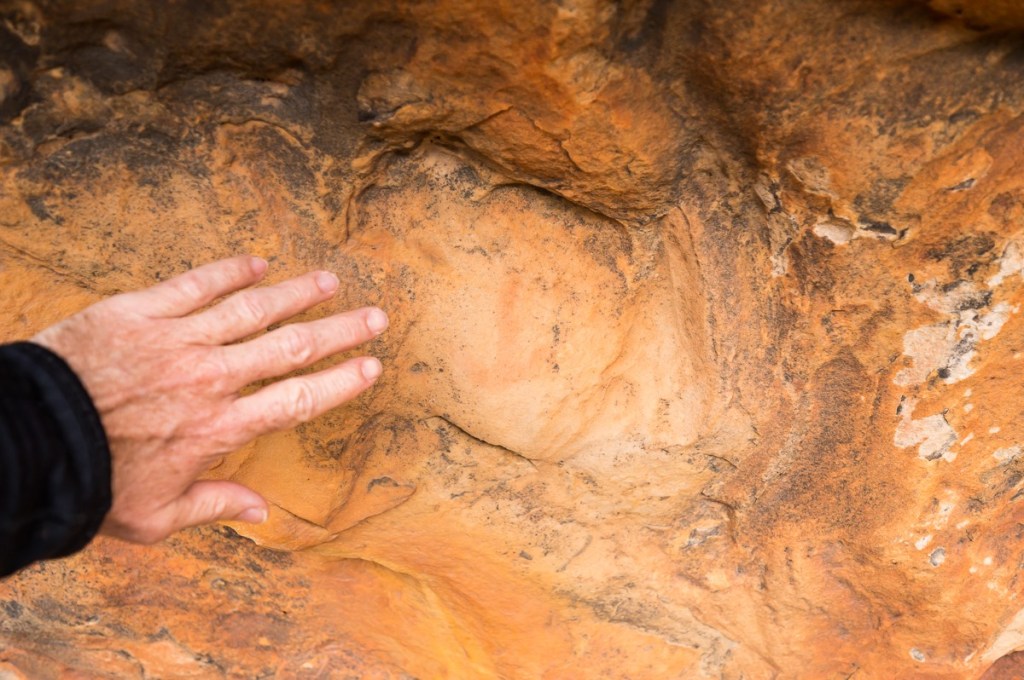
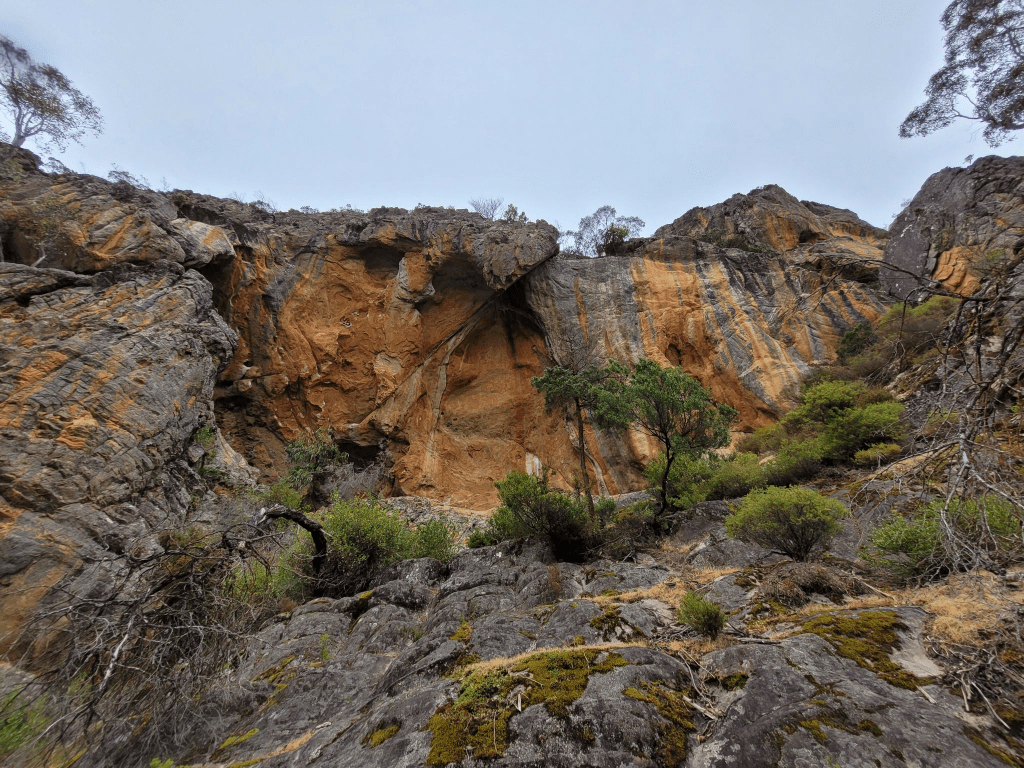
Rock climbing at Millennium Caves became the subject of restrictions in 2019. It was one of 8 “focus sites” singled out to protect cultural heritage. A small faded emu foot, painted in ochre has been well known to climbers for 25 years. The painting has been recorded in climbing guidebooks and has been carefully protected by climbers. We are not sure who first found it. The painting is difficult to spot, among the multi coloured rock surfaces. Adventurous bushwalkers quietly travel these areas along with other curious types such as birdwatchers, botanists, photographers and archaeologists.

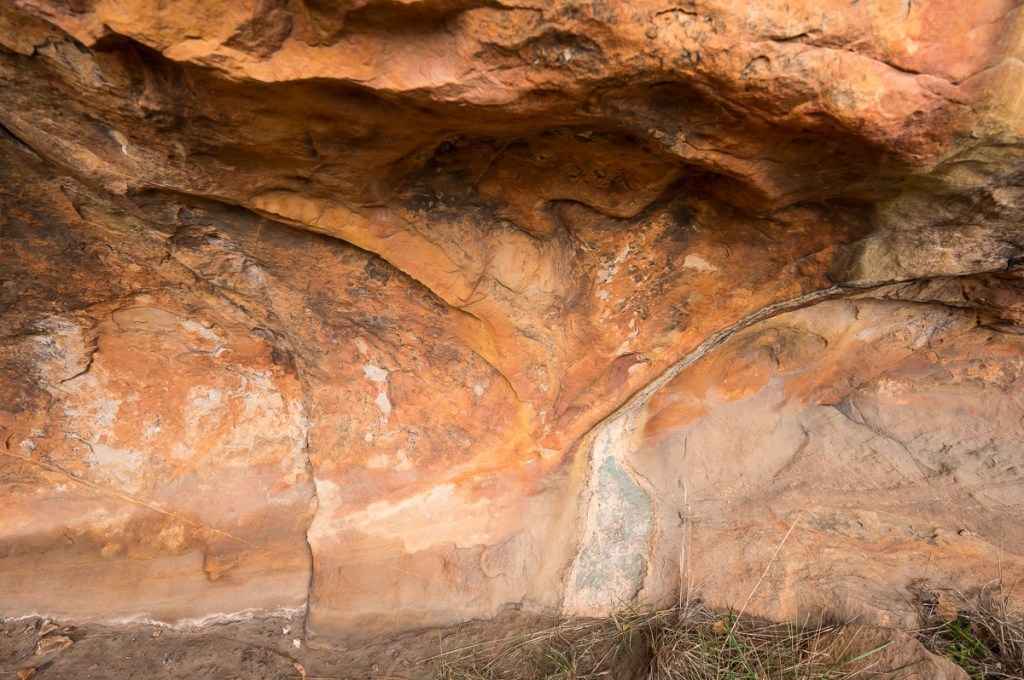
The emu foot painting
Wider shot of the art location. The painting is visible if you know where to look
The art site is on the right side of the cave. The main steep part of the cave is further left.

Other, more subtle artifacts are rumoured to exist but nothing has been revealed to the public regarding this chapter of human history. Cliffs elsewhere in the Grampians have been hit with climbing bans to protect faded art or pre-colonial rock scars. Some of this art is invisible without image enhancement. Visible or not, this art must be somehow protected. Centuries of bushfires have significantly affected the landscape and the rock surfaces. A major bushfire will destroy any artwork at the cliff base, with the lower rocks being smoke damaged, burned or even exfoliated.

Parks Victoria staff attempted to remove bolts from Millennium Cave in 2019, using a ladder and basic tools. This initiative was eventually aborted, leaving behind a few messy and dangerous bolts, still in the rock. These world class rock climbs are documented in tens of thousands of printed guide books.

There is no permanent signage to clarify the latest climbing status. Travelling climbers may not be aware of local restrictions. The park manager causing damage to safety infrastructure in this way could be considered reckless. Thankfully, no one has been hurt, to our knowledge.

When a UNESCO world heritage register of rock climbs is drawn up, Millennium Caves will represent the best of Australia on that list (dreams)

In March 2023, Parks Victoria issued an Expression of Interest (EOI) document to Licensed Tour Operators (climbing guiding companies), seeking to employ climbers to remove climbing bolts from the lower Millennium Cave, paint over any chalk stains and fill unnatural holes with coloured silicone. This EOI was leaked to the climbing community via the company owners.

Save Grampians Climbing: PV Cuts Corners to Chop Bolts (Dodgy Tour Operator Proposal Revealed)

The EOI scope of work described bolt removal activity at only one of the four Millennium Caves that climbers have frequented in this immediate vicinity. We are unsure why only one of the four caves was singled out for these works. Access difficulty on foot is certainly a factor for 21st century city dwellers.

Community reaction to the EOI was mixed. The most mystifying issue was Parks Victoria’s apparent ignorance of the industrial high access industry. Qualified and highly paid rope access professionals are routinely employed to clean windows on tall buildings such as the Parks Victoria Bourke Street office, yet this complex, delicate and dangerous cave project was deemed to be within the remit of tourism companies and climbing instructors.

Of course, any head contractor would have the option to appoint suitably qualified subcontractors, deemed to be capable of the works. We have no confirmation of any high access subcontractor involvement or supervision to reassure the community over safety and environmental concerns.

Indeed many climbers are aware that Parks Victoria previously employed an Archaeologist and an Art Conservator in 2019 to supervise the repair of bolt holes that the parks service had made, years ago in a sensitive location.

We are unaware of the details of the tender process, however it recently became apparent that one of these tour operators had actually taken on this industrial high access project and was preparing to begin the bolt removal works on 22 May 2023, as originally planned in the EOI.

News of the impending workplace commencement became known to the wider climbing community and discussions ensued in person and on social media. No hard information was made available at this point.

The contractor then issued a statement on his blog, going some way to explaining his contract and his intent to proceed, but not his methodology.

Community debate continued, but for some reason, the project was abruptly cancelled, postponed or mothballed, four days before it was due to start on site.

Parks Victoria has issued no new information since their original EOI request in March and we have no idea why the bolt removal scheme was halted.

In response to a fact checking request for this article, the contractor declined to comment. We have received no response to our technical or safety queries. No information was offered to reassure concerned climbers over safety or environmental damage. Experienced climbers and high access professionals still cannot perceive how these bolts can be safely removed using industrial workplace methods, without significant damage to the cave, including further drilling into the rock.

Parks Victoria responded to our written correspondence with their customary brevity.

It is possible that the project plan may have failed to achieve a Safe Work Method Statement during the planning stage. In hindsight, it may be fortunate that the climbing community stepped in to ask questions. The work method statement may be a problem or there could be other obstacles such as budget constraints, insurance difficulties or a gathering perception of a lack of community engagement

We would also expect further compliance challenges ahead for Parks Victoria, should they wish to proceed. Where is the Environmental Impact Statement? Will environmental offsets be used as a management tool, as was attempted for the construction of the 160km Grampians Peaks Trail through the same remote country?

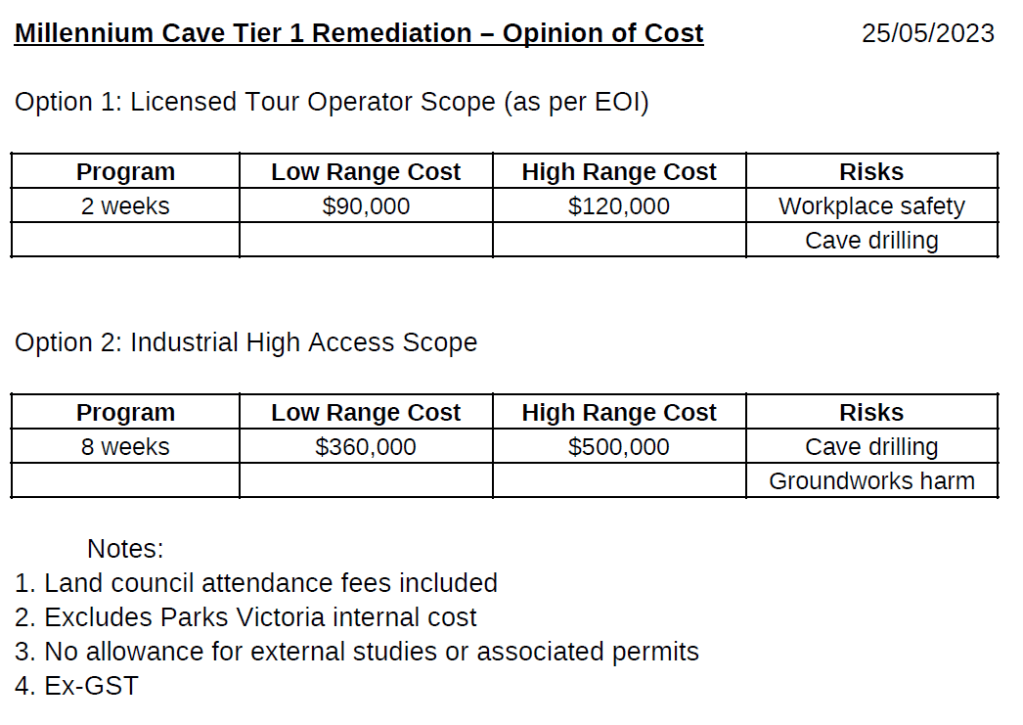
Industry insiders have raised a likely need for greater focus on traditional worksite access methods such as scaffolding and even the use of helicopters to fly in materials. Although new rock drilling to stabilise the work platforms would be essential for any safe access method. The budget could escalate into hundreds of thousands of dollars for the contractor’s works alone. The program in this case would extend far beyond the estimated 2 weeks. Environmental damage would scale up accordingly.

Cost for land council attendance would, in all likelihood, surpass the dollar total for the engineering side of the works. Representatives from each of the three surrounding land councils would expect to attend at Parks Victoria expense.

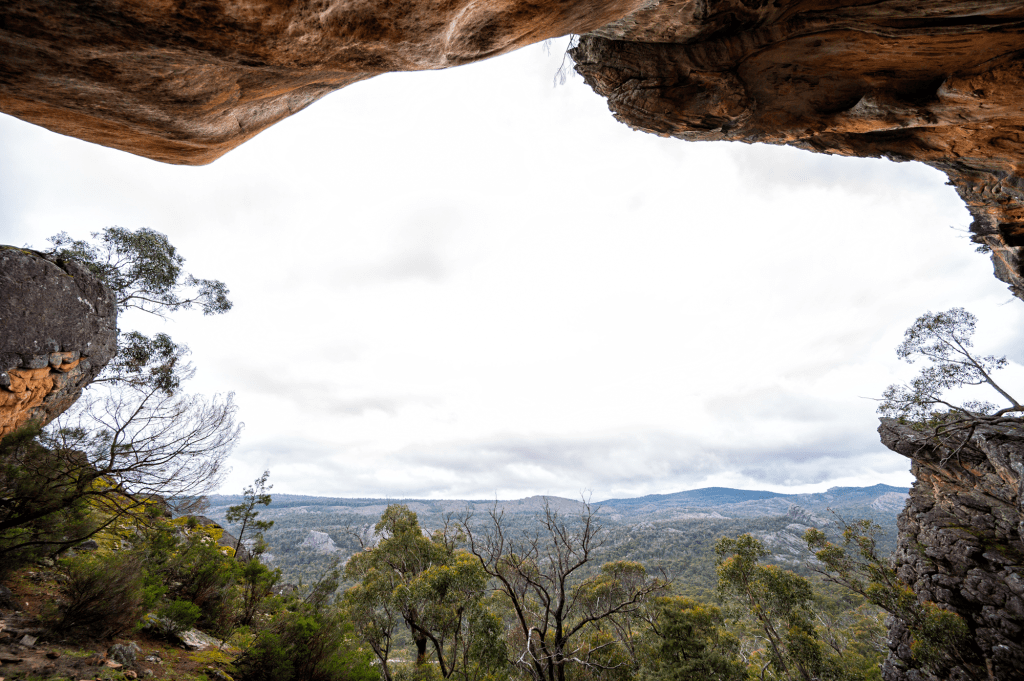
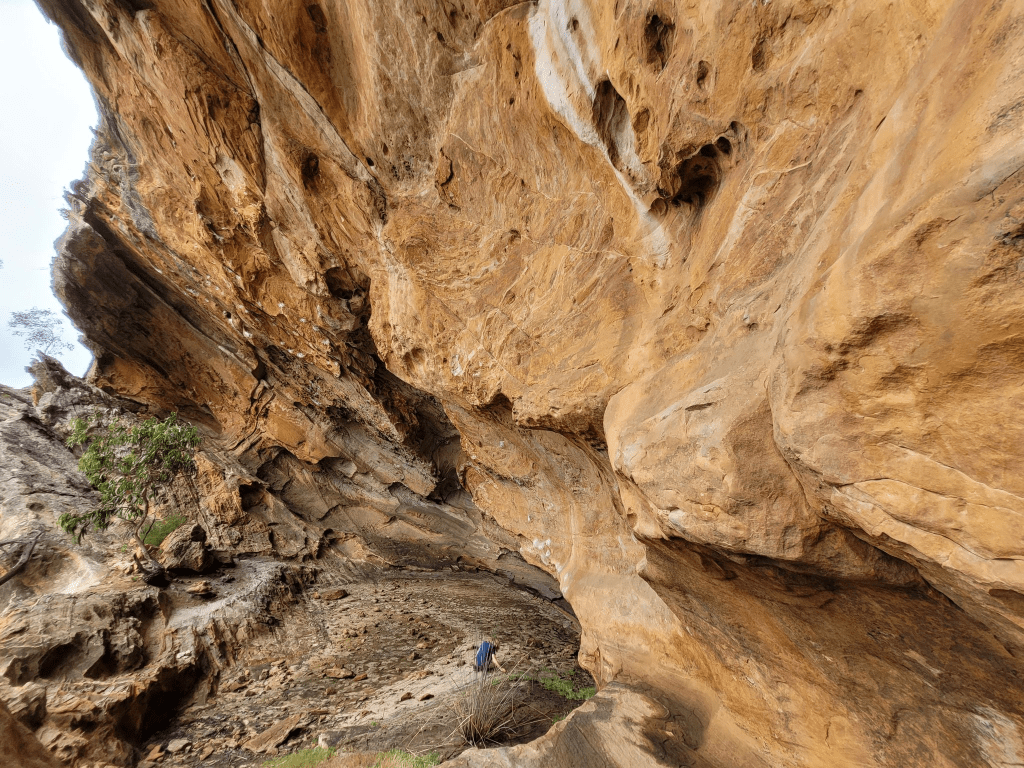
Access to the proposed worksite can be difficult

Qualified experts in the high access field have raised concerns that any attempt to remove the cave bolts in any workplace-compliant manner, may cause significant damage to the cave walls, the cave ceiling, the cave floor and the wider local environment.

Our fact check inquiry was also sent to a handful of climbers who, from their public statements, appeared to have inside knowledge of the project. None of these individuals was willing to go on the record or confirm any involvement.

The proposed work methodology remains a mystery and a cause for concern among those who know and love this place. It would be interesting to review an approved safe work document if and when it becomes public knowledge. A project of this nature has never been done before, to our knowledge.

It is worth noting that very few climbers have the requisite skills to carry out bolting works at these steep angles. Climbers have a range of recreational climbing techniques available to them that would not be compliant with the more stringent requirements of workplace safety standards.

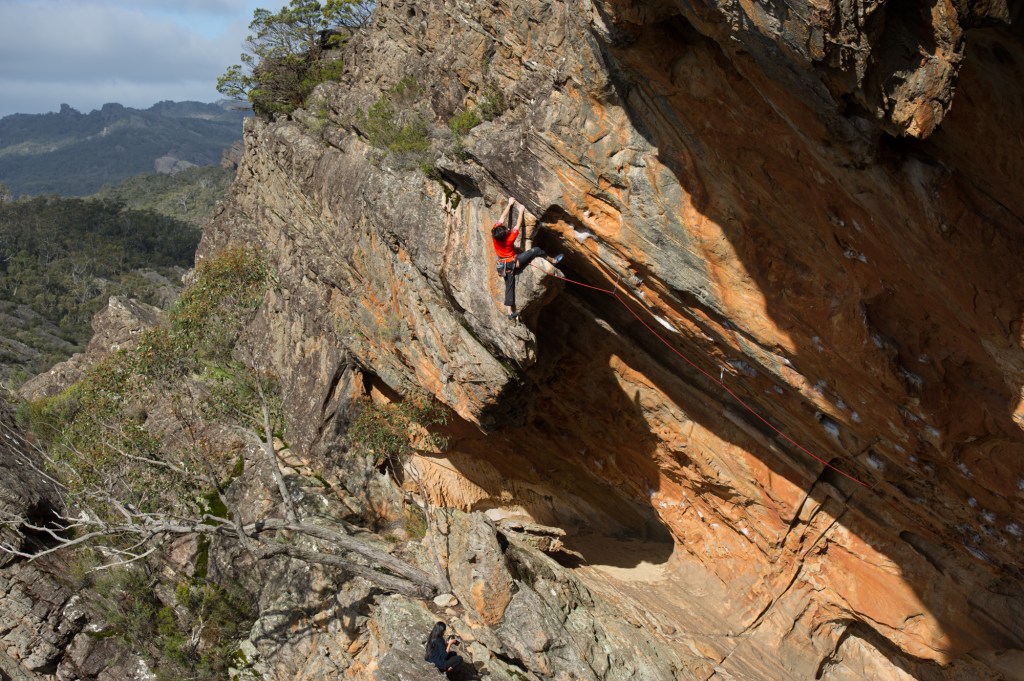
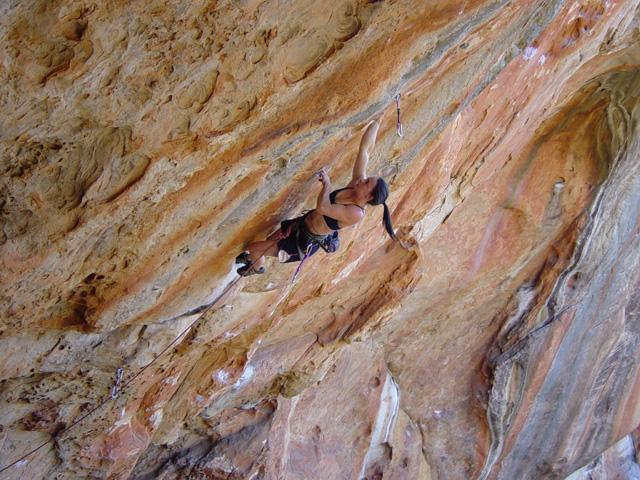
A climber up on the third tier of the cave complex
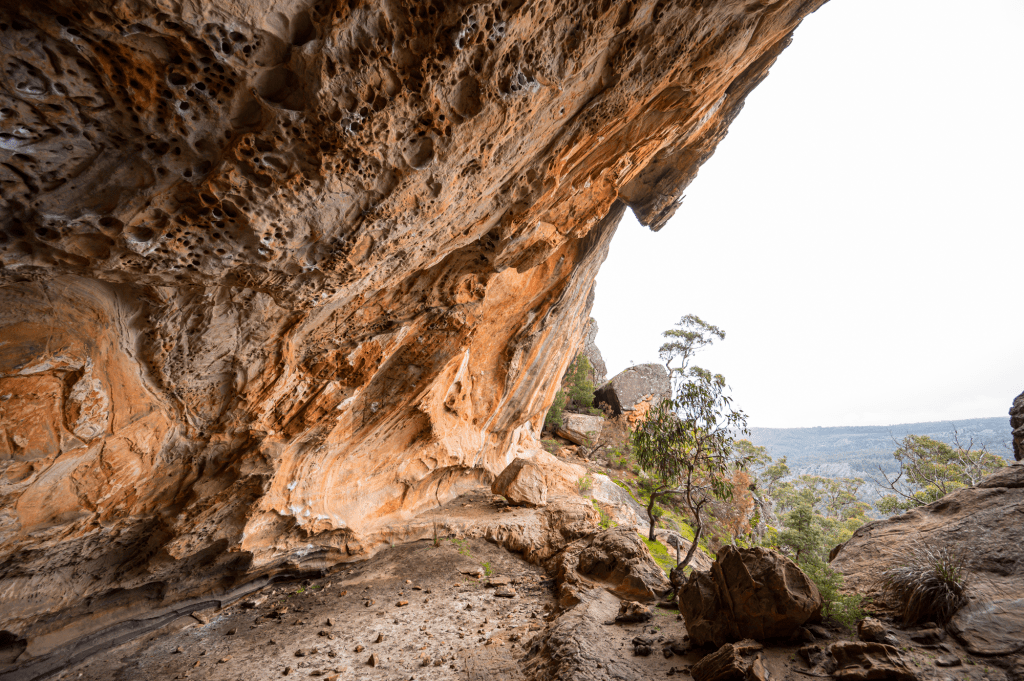
The large caves of the second tier

The future of the Parks Victoria bolt removal concept remains unknown as the first cave tier has not, as yet, become a work site. It is possible that this proposal will be revisited in the new financial year, before the Parks Victoria budget is fully committed to more traditional activities. Although spending up to half a million dollars on just one of four caves, may not present acceptable value to the Parks Victoria CEO.

After four years of closure, there are rumours around the archaeological significance of the cave. The botanists, birdwatchers and everyone else must give up their curiosity and care, for the sake of secretive archaeology.

New Signage

New temporary signs were installed at the cave yesterday, including this one:

Temporary sign at the cave – Page 109 of the 185 page Grampians management plan

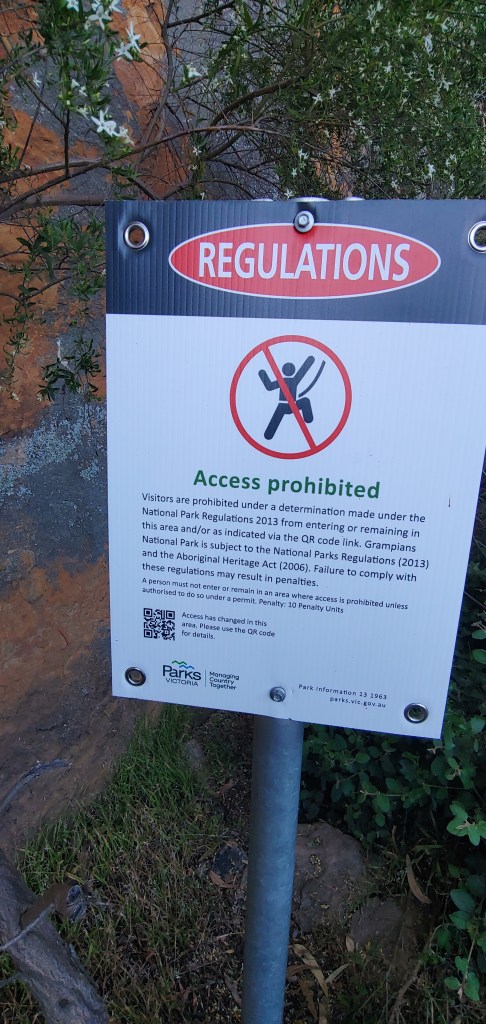
The meaning of this sign will be lost on most visitors. Certainly without the context of the other 184 pages. Thankfully there is a QR code link on another sign but sadly there is no mobile coverage in the region.

Keep out

The absurdity of this “exclude everyone from a national park” legal framework has been highlighted previously by ACAV in this article: ACAV Calls For Withdrawal of “All of Park” Access Bans

Nobody knows the origin of the individual who mixed up an ochre paste and painted an image of an emu foot in a remote cave all those years ago. The actions of this man, woman or child have certainly echoed down the ages, causing us to reflect on the lessons of history.

*******************************

Rock climbing is successfully managed internationally, using collaborative management methods, as described within the Victorian Climbing Management Guidelines.

Please support the work we do at ACAV

Join as a member for $15

To renew an expired membership, please visit the membership portal: https://vicmembers.climb.org.au/portal

You are invited to join our Facebook discussion group: ACAV Access Discussion

Ongoing feedback and assistance is always welcome: acav@climb.org.au

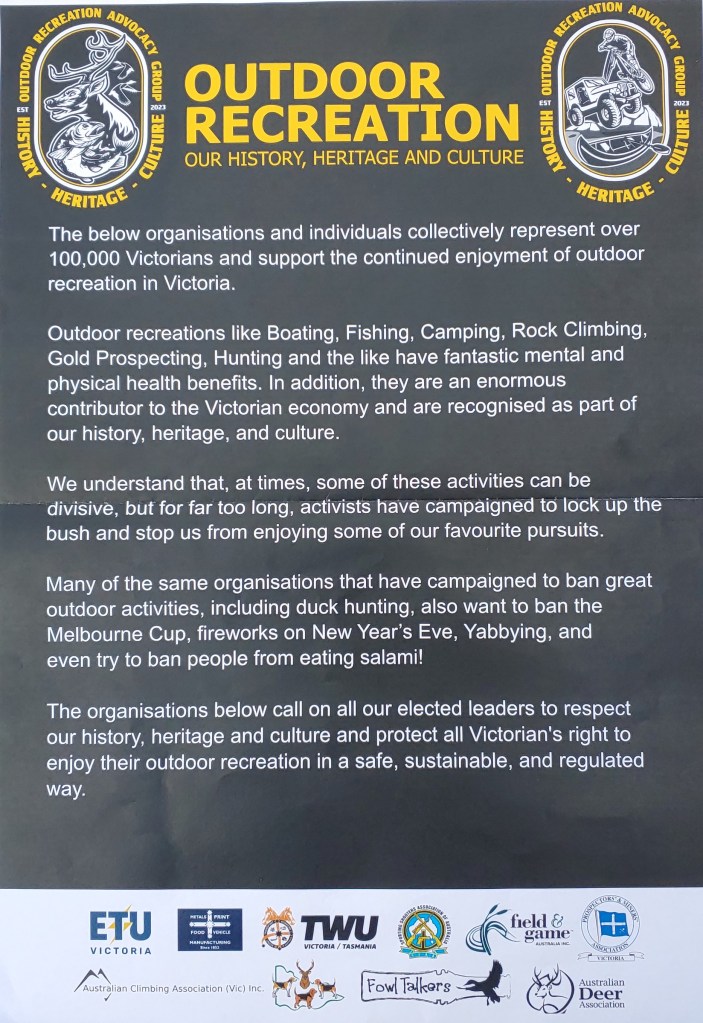
The Outdoor Recreation Advocacy Group

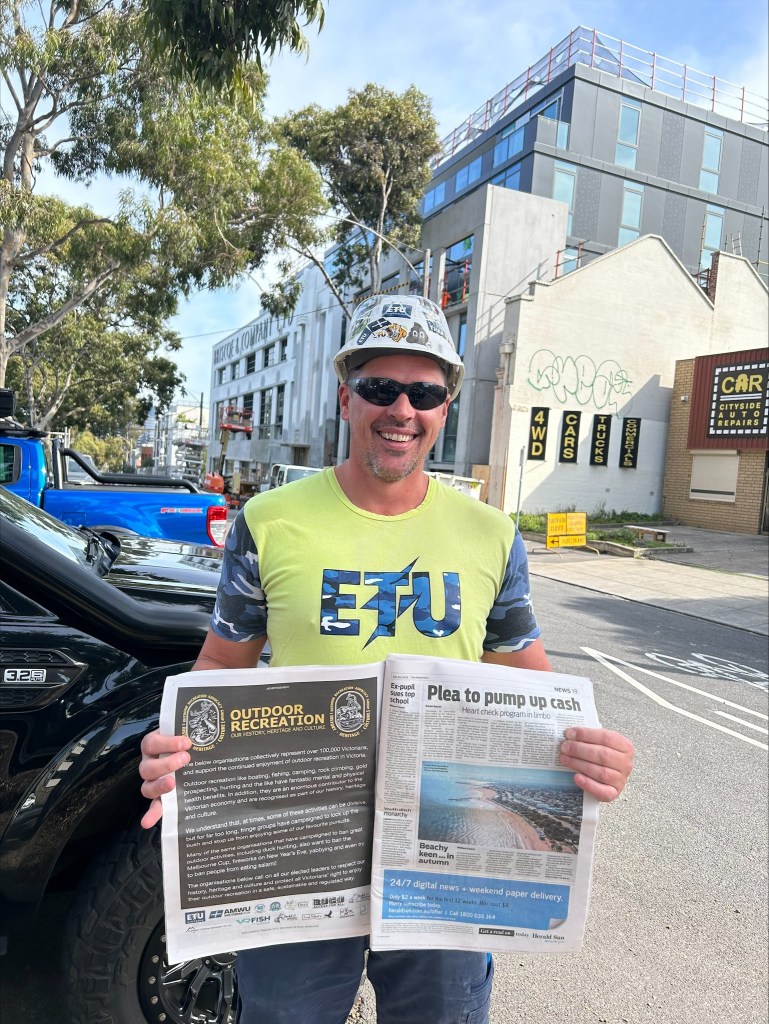
The ACAV has joined several outdoor organisations in support of a new advocacy group, convened by the ETU – Electrical Trades Union of Australia, Victorian Branch.

The union has grown increasingly concerned about restrictions on members’ outdoor recreation activities outside working hours. The catalyst for this group formation was recent renewed pressure to ban duck hunting in Victoria.

https://www.canberratimes.com.au/story/8143900/hundreds-of-electricians-walk-off-vic-metro-tunnel-job/

Members of the group include hunters, fishers, the bush user group, prospectors and several others. The Australian Manufacturing Workers Union is on board and support from other unions is anticipated. Target group membership is 500,000.

On Wednesday 26th April 2023, the ETU funded full page advertisements in the major Victorian newspapers:


The message to the government:

ETU Vic Facebook post

Yes the Animal Justice Party is coming after salami and bacon!

In recent years the Victorian government has used various measures to lock up land and heavily restrict healthy and wholesome pursuits. The Grampians all-of-park set aside bans are a prime example of this and we contend that Parks Victoria is contravening the National Parks Act 1975. We are pleased to be in alliance with strong outdoor groups to lobby for reasonable access for our outdoor recreation activities. Further developments will be reported as events unfold.

*****************************************************************

Rock climbing is successfully managed internationally, using collaborative management methods, as described within the Victorian Climbing Management Guidelines.

Please support the work we do at ACAV

Join as a member for $15

To renew an expired membership, please visit the membership portal: https://vicmembers.climb.org.au/portal

Ongoing feedback and assistance is always welcome: acav@climb.org.au
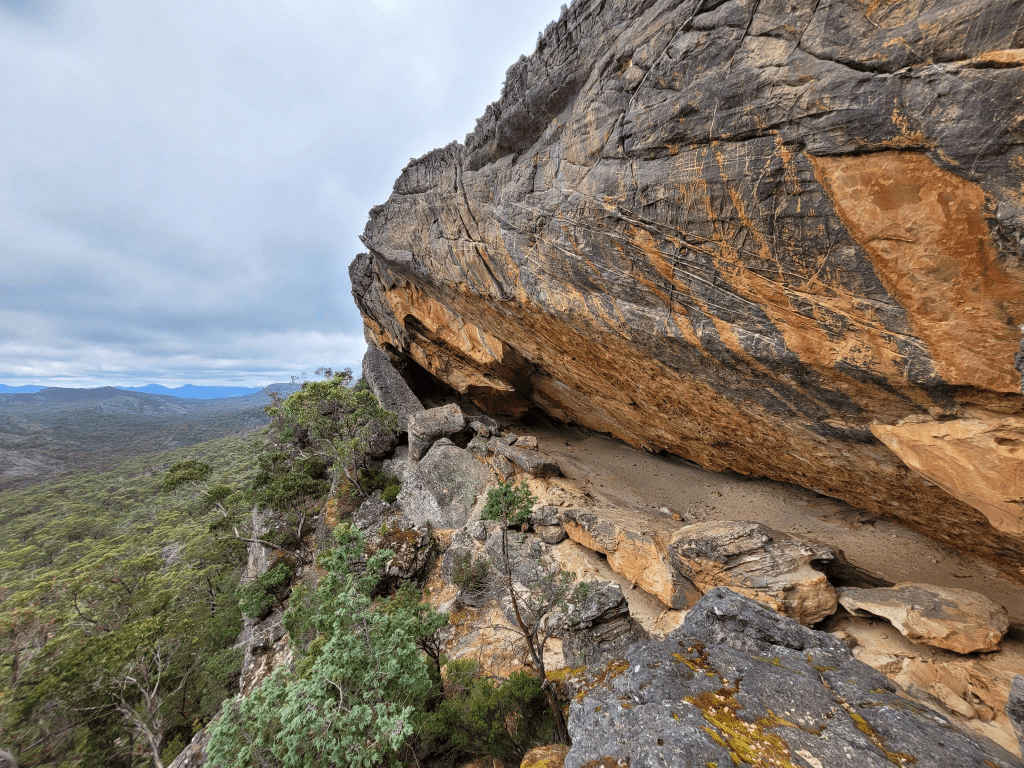
Covid Regulations Abused to Ban Grampians Climbing

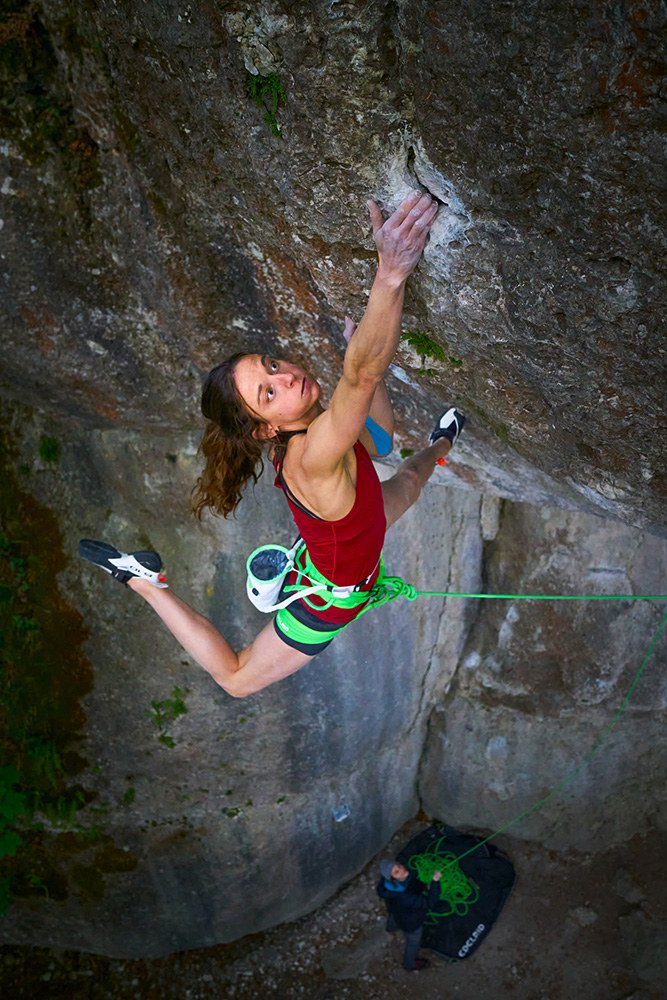
Inspiring climbing achievements are happening in Europe. Ground-breaking ascents of athletic and adventurous climbs are reported regularly on climbing news channels.

Melissa Le Neve completing the first female ascent of Action Directe,
Frankenjura, Germany, 2021 (Photo: Fabi Buhl)

Youtube – Melissa Le Neve – The 9a That No Woman Could Do – Reel Rock

Things are much quieter in Australia. International climbers generally perceive that in Australia, everything is banned. The world has moved on, leaving Australia behind.

All of Park – The World’s Most Extensive Rock Climbing Bans

In March 2022, Parks Victoria banned more than three quarters of rock climbs in the world-famous Grampians National Park. To bring this about, they flipped on its head, the concept of National Park Access. In a highly irregular and controversial move, Parks Victoria introduced all-of-park access bans, banning everyone and everything by default, before deeming some activities to be “allowed” under tightly controlled rules, drawn up in a management plan.

ACAV challenged this legal precedent in June 2022.

ACAV Calls For Withdrawal of “All of Park” Access Bans

The all-of-park ban methodology has also been challenged on the floor of the Victorian Parliament. The impacts are now being felt by walkers and other groups.

Victorian Legislative Council – Grampians track closures 21 Feb 2023

“Prior to March last year, the whole park was deemed accessible, with only small parcels ruled off-limits, or ‘set aside’. Since then, the whole park is now deemed off limits, and access only granted to smaller parts.”

Bev McArthur MP, 24 Feb 2023

The Park Regulations Were Amended in 2020 – Under Cover of Covid

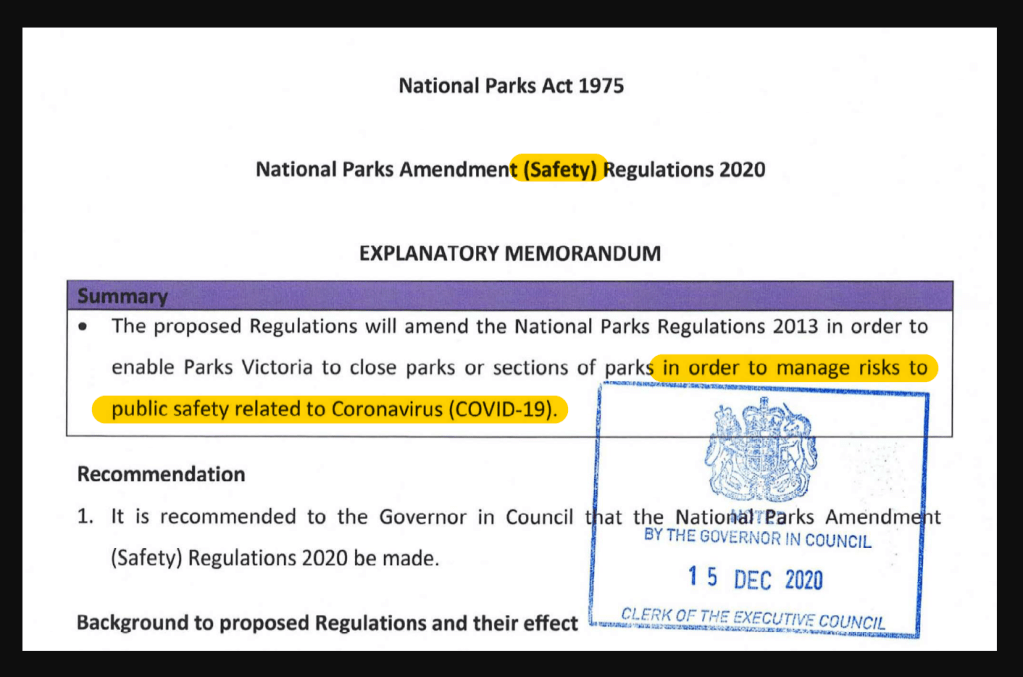
To bring about the Grampians all-of-park bans in 2022, it was first necessary for the Victorian Environment Minister to approve an amendment to the National Parks Regulations 2013.

Amendments to the Regulations are normally made for sound, long-term operational reasons. However, in this case, the December 2020 amendment was made for a temporary emergency: “in order to manage risks to public safety related to Coronavirus (COVID-19).

National Parks Amendment (Safety) Regulations 2020

Title page and summary of the National Parks (Safety) Regulations 2020

There may be short-term reasons why entire parks should be closed (e.g. bushfire) but there can be no long-term justification for an all-of-park closure.

Victoria’s Covid-19 state of emergency ended on Wednesday 12th October 2022. Associated restrictions have since been lifted, across all walks of life. The Covid-19 safety amendment to the park regulations can no longer be applied. Parks don’t need to be closed for infectious disease control. Any associated all-of-park access bans must now end.

We note that several other methods of Covid-era enforcement turned out to be legally invalid and thousands of fines have been withdrawn.

The Guardian – More than 33,000 Covid fines withdrawn in NSW after adverse court ruling

The National Parks Amendment (Safety) Regulations 2020 is Obsolete

It is unfortunate that the all-of-park set aside instrument, invoked within Parks Victoria’s 2021 Greater Gariwerd Landscape Management Plan, is no longer viable.

  • Significant restructuring of the Greater Gariwerd Landscape Management Plan will now be required to properly protect vulnerable locations. Parks Victoria must revert to small, discrete set asides in accordance with the intent of the legislation.
  • Any associated climbing permit system is untenable.
  • Any access restrictions proposed for other Victorian parks cannot utilise the all-of-park set aside instrument.

We note that the quarterly meetings occurring between Parks Victoria and the CVAC collective of climbing groups, appear to have become hamstrung. A quarterly meeting came and went on 28th February 2023. There has been no meeting report. There is no apparent progress on opening up Grampians cliffs, the introduction of climbing permits or the future of climbing at Mount Arapiles.

What is the Legal Position?

To further review this regulatory muddle, our legal advisors have prepared a paper to clarify broader inconsistencies and limitations of the safety amendment and the all-of-park bans, overlaid within the context of The National Parks Act 1975.

ACAV – How does this amendment to the National Parks Regulations serve the public good?

We have previously documented the legal fragility and management challenges involved in Parks Victoria attempting to sustain the world’s most extensive rock climbing bans.

ACAV – Can I Be Fined For Climbing Rocks?

ACAV – What’s the go with Grampians Rangers?

We believe the widespread bans are fundamentally non-compliant with the principles of The National Parks Act 1975. In addition, the scale and topography of the Grampians makes enforcement impractical, especially under these legal limitations. Public cooperation and support is essential for the effective management and protection of these precious environments.

We contend that, in the absence of Covid-19 public safety restrictions in National Parks, the all-of-park set aside legal instrument is null and void. We believe that the Grampians all-of-park access bans are illegitimate.

ACAV – March 2023

Anyone receiving a climbing-related infringement notice is advised to contact ACAV for further advice. It may be beneficial to challenge an alleged climbing offence in the Magistrates Court, with assistance from ACAV. Defending an individual infringement is inexpensive. All members will be supported to the extent of funds available over this critical issue of access for all park users.

We would like to see the appropriate application of small, discrete set-aside areas for the proper protection of the most valuable cultural sites, especially rock art sites. We also support the set-aside protection of delicate environmental zones within our parks. 

*****************************************************************

Rock climbing is successfully managed internationally, using collaborative management methods, as described within the Victorian Climbing Management Guidelines.

Please support the work we do at ACAV

Join as a member for $15

To renew an expired membership, please visit the membership portal: https://vicmembers.climb.org.au/portal

Ongoing feedback and assistance is always welcome: acav@climb.org.au
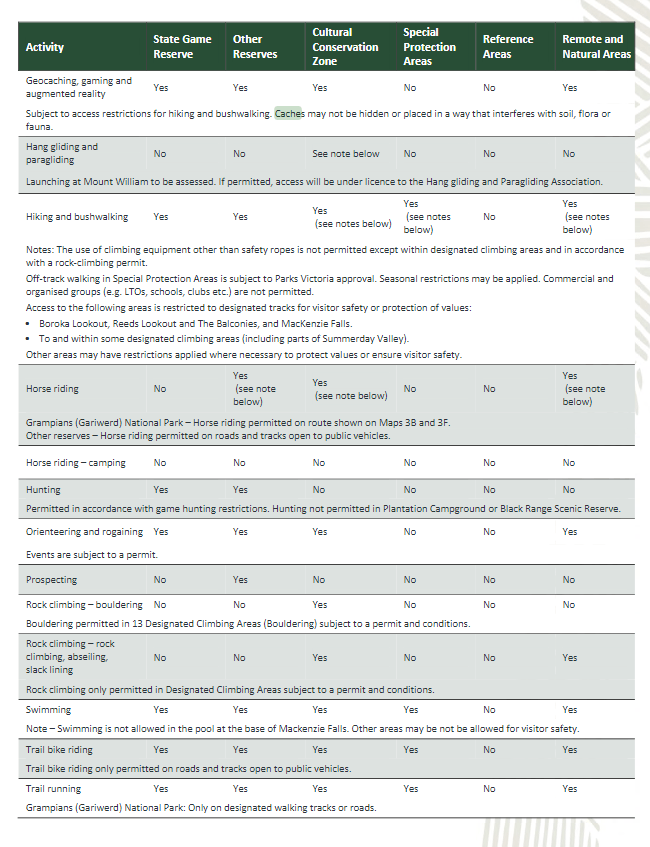
The Demise of National Parks in Victoria

Last week in the Victorian Legislative Council (Upper House), Bev McArthur MP raised alarming concerns over National Park access during a Constituency Question.

“My constituency question is for the Minister for Environment. Parks Victoria has recently closed some of the best and most historic walking tracks in the Grampians, including Briggs Bluff, Dellys Dell, Mount Difficult and Mount Rosea. Wild camping and scrambling across rocks has also been banned. These walks are in terrific condition, but their closure and the camping ban forced tourists to the $33 million Grampians Peaks Trail at a cost of nearly $50 a night. Can the minister confirm that the closure and banning of these traditional walking paths and activities has got more to do with reducing the management needs of the park and directing people to government money-making options and say whether these changes represent the blueprint for the demise of other national parks in Victoria.”

Bev McArthur MP – 21 Feb 2023

Hansard record

Video of the question in the house

Bev McArthur expanded further in a subsequent media statement:

Media Statement: Be Alert – And Alarmed

“The Victorian Government’s increasingly draconian controls over the Grampians National Park continue to be revealed. In recent weeks, Member for Western Victoria, Bev McArthur, has questioned the Andrews Government’s ‘set-aside’ regulations for the park which effectively reverse public access rights provisioned in the National Parks Act 1975.”

Bev McArthur MP – 24 Feb 2023

While climbing groups try to improve behavior and attempt liaison with Land Councils, Parks Victoria is systematically shutting down more and more locations to all user groups. Dispersed camping is due to be banned in 2024. The only approved multi-day walks will be on the (paid) Grampians Peaks Trail.

We note that approval to build the GPT required environmental offsets. Did Parks Victoria sacrifice existing walking tracks to allow a single large track to be newly constructed through virgin bushland? We suspect that GPT deals may have brought about the closure of many of these historic walking tracks. We contend that such management practices would contravene the National Parks Act 1975.

*********************************************************

Rock climbing is successfully managed internationally, using collaborative management methods, as described within the Victorian Climbing Management Guidelines.

Please support the work that we do at ACAV

Join as a member for $15

To renew an expired membership, please visit the membership portal: https://vicmembers.climb.org.au/portal

Ongoing feedback and assistance is always welcome: acav@climb.org.au
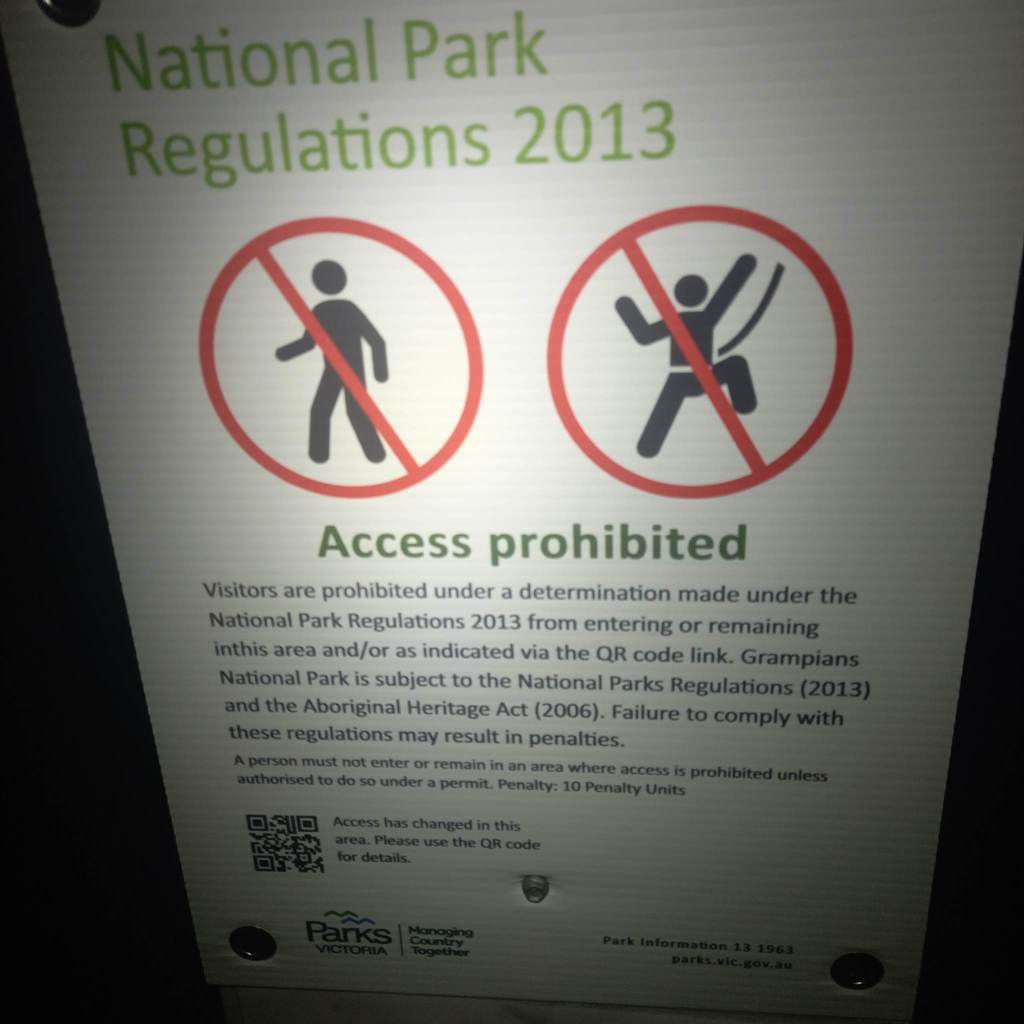
What’s the go with Grampians Rangers?

Back in the day (not far back, only 2018) climbers and park rangers drank cups of tea around the camp fire while telling stories and sharing knowledge: “we cleared away that fallen tree on the Waterworks Track”, “nice one, thank you”.

Everything changed in November 2018. Something shifted within Parks Victoria and climbers have been seen in a negative light since then. Save Grampians Climbing and this ACAV website have all the background on the Grampians access crisis.

The Labor Day 2019 Incident

See article by Save Grampians Climbing:

PARKS VICTORIA OUT IN FORCE OVER LONG WEEKEND

The Taipan Wall, December 2022 Incident

This incident at Taipan Wall on ‘opening day’ is described in an ACAV article:

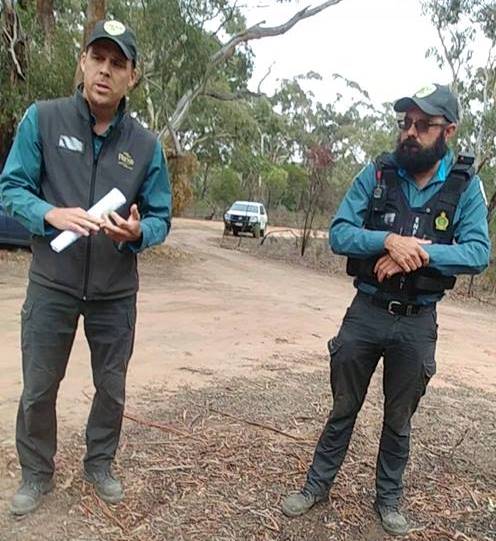
Ranger Interaction at Taipan Wall

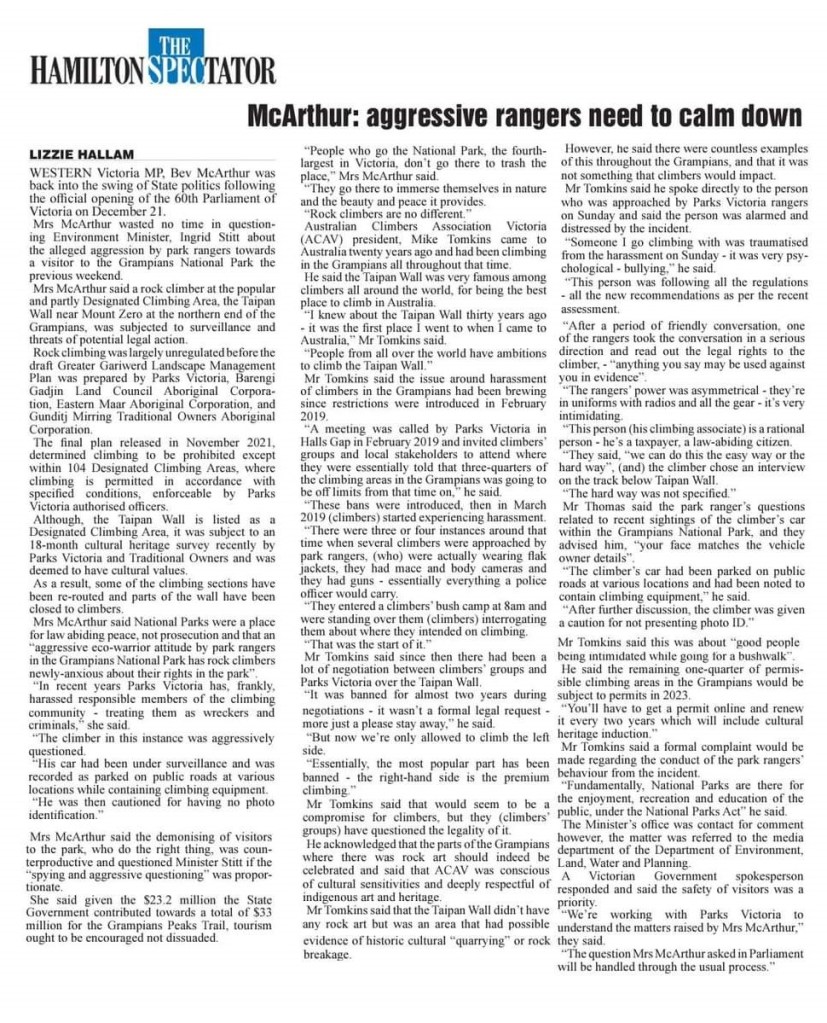
The “aggressive rangers” story was subsequently reported in the press and questions were asked in Parliament.

A formal complaint has recently been submitted to Parks Victoria by the complainant, over the behaviour of the two rangers at Taipan Wall.

Climber complaint To Parks Victoria 21-Feb-2023


“After this meeting I had trouble sleeping. I have met with a social worker to discuss the situation and the effect it had on me. Both me and my partner are still feeling distressed about the events that happened. We feel anxious about going to the Gariwerd National Park now, which hurts because it is important for both my physical and mental health. I am extremely concerned that I will be approached by Parks Victoria Officials in a National Park with further accusations.”

Quote from the Climber’s complaint letter

This shocking story has also been published on Save Grampians Climbing:

HARASS AND INTIMIDATE: Parks Victoria Goes Cops on Climbers

ACAV RECOMMENDATIONS IN THE EVENT OF A RANGER INTERACTION

PART ONE

In light of these confronting events, we would advise ACAV members to learn more about the limited authority of park rangers in their work as public servants under the law. If a park ranger approaches and asserts any official authority, we make the following recommendations:

  • Remain polite, respectful and calm. Do not answer questions or volunteer information.
  • The ranger must first produce formal identification before proceeding. Take a photograph of both sides of the ranger’s ID card. The card must show that the ranger is an authorised officer under the National Parks Act 1975. We understand that most rangers are suitably authorised.
  • Record the whole interaction on video. Give prior notice of this. Ask the ranger to start again for the camera. Establish your authority in this situation.
  • For any formal interaction to continue, the ranger must assert an appropriate offence under the National Parks Regulations 2013, e.g. climbing offence, camping offence, bushwalking offence, damaging vegetation etc. Further information on the limitations of potential offences can be found in this ACAV article:

Can I Be Fined For Climbing Rocks?

DO NOT ALLOW THE INTERACTION TO PROCEED WITHOUT “AUTHORISED OFFICER” ID AND THE ALLEGATION OF AN OFFENCE UNDER THE NATIONAL PARKS REGULATIONS 2013.

If these two conditions are not met, you may wish the ranger a “good afternoon” and continue with your day.

PART TWO

If an offence is formally alleged, the ranger is likely to proceed as follows:

  • You may be ‘read your rights’. Rangers have recently described this procedure as a ‘caution’. The Parks Victoria script includes: “you do not have to say or do anything, but anything you say or do may be given in evidence, do you understand that?” Do not acknowledge understanding. Do not accept the terms of any ‘caution’. Do not say or do anything. Take the legal advice from the script and do not risk providing evidence against yourself while you are taken aback and under pressure. Remain completely silent at this point. You are protected under the law. This is not an interview. You are not required to answer questions.
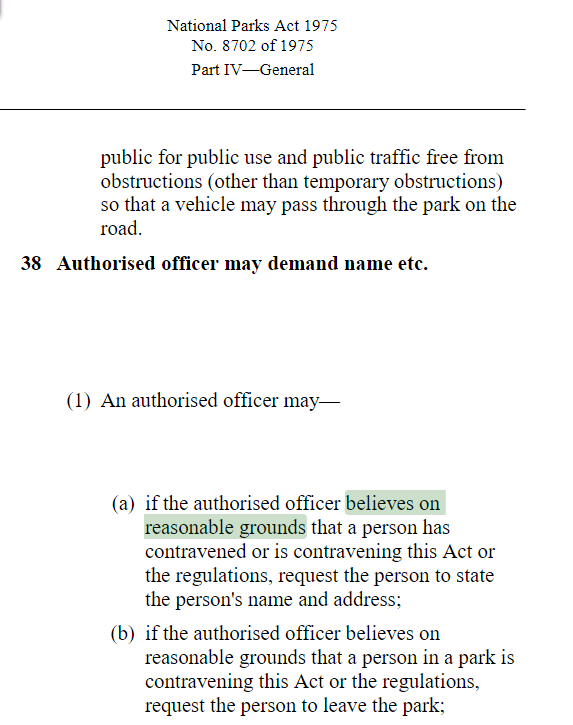
  • The ranger may ask your name and address. You are required to verbally state your name and address. You are not required to carry formal ID. You are not required to provide proof of identity in a park.
  • The ranger may direct you to leave an area or a park. You are required to leave the area or the park as directed.
  • The ranger may issue you with an infringement notice, stating your name and address and alleging an appropriate offence under the National Parks Regulations 2013.

If you receive a climbing-related infringement notice, please contact ACAV for further advice. It may be beneficial to challenge the alleged offence in the Magistrates Court, with assistance from ACAV. Members will be supported to the extent of funds available over this critical issue of public park access.

We understand that Parks Victoria has never issued an infringement notice for any offence associated with rock climbing.

National Parks Regulations 2013 (at 15 Dec 2020)

National Parks Act 1975 (at 01 Sept 2022)

*********************************************************

Rock climbing is successfully managed internationally, using collaborative management methods, as described within the Victorian Climbing Management Guidelines.

Please support the work that we do at ACAV

Join as a member for $15

To renew an expired membership, please visit the membership portal: https://vicmembers.climb.org.au/portal

Ongoing feedback and assistance is always welcome: acav@climb.org.au
Can I Be Fined For Climbing Rocks?

After four years of escalating climbing restrictions across the Grampians National Park, the time has come to ask this question. Recent restrictions at Australia’s premier climbing location Taipan Wall, have prompted ACAV to query Parks Victoria, over the consequences of being approached by a ranger and potentially fined for entering the Taipan Wall right side zone and for climbing the rocks. No fines have been issued in Victoria, for climbing rocks or for entering restricted areas.

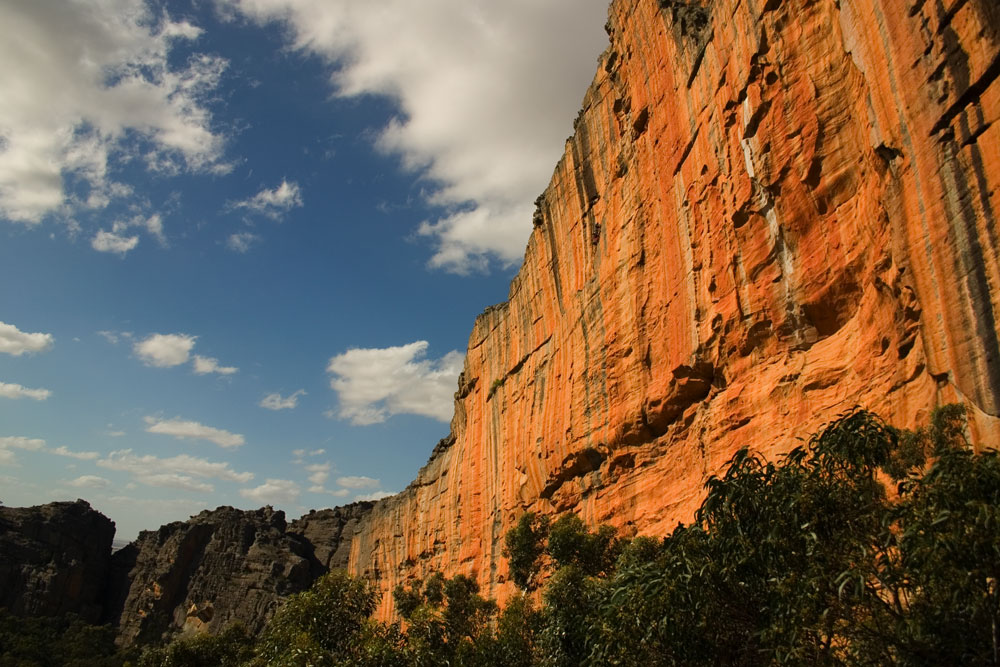
Taipan Wall, Grampians National Park

We have not been made aware of any rock art discoveries at Taipan Wall

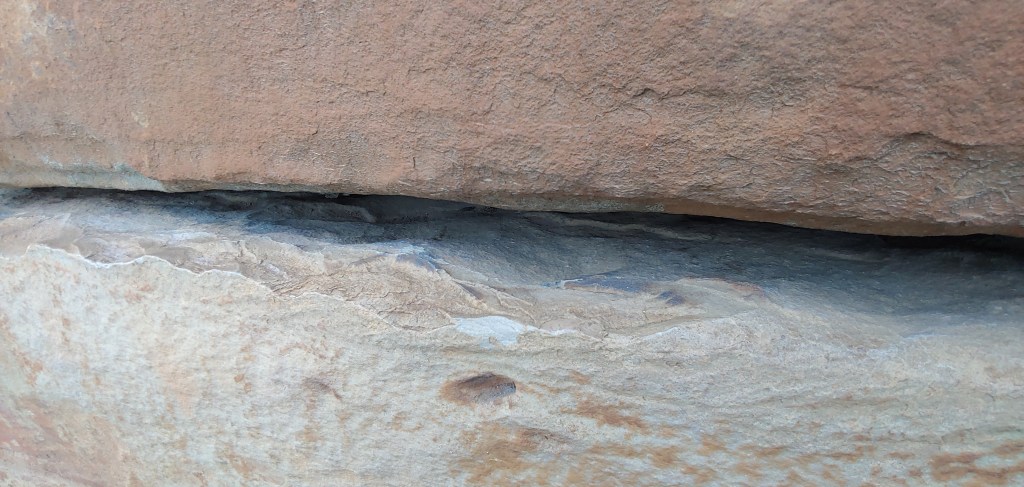
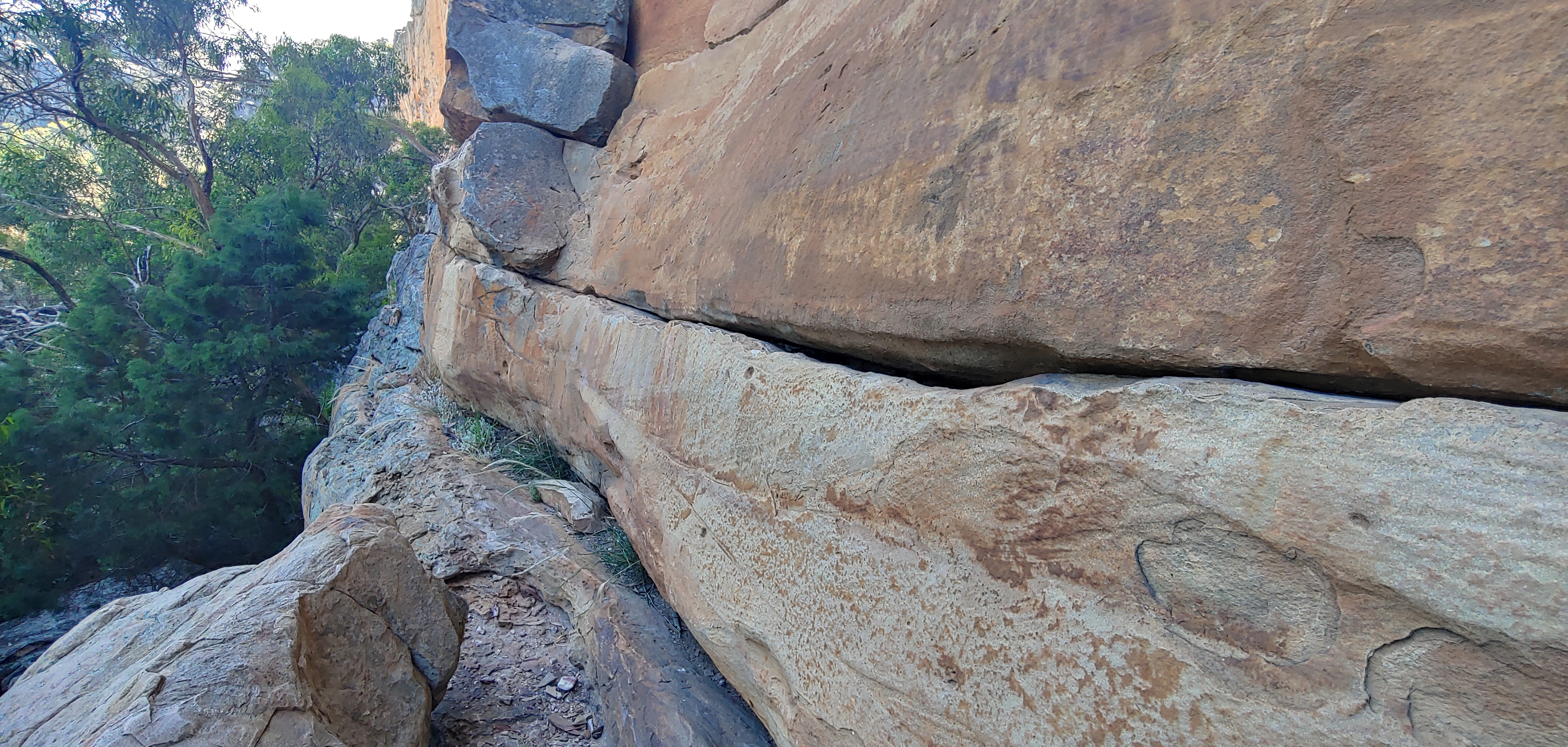
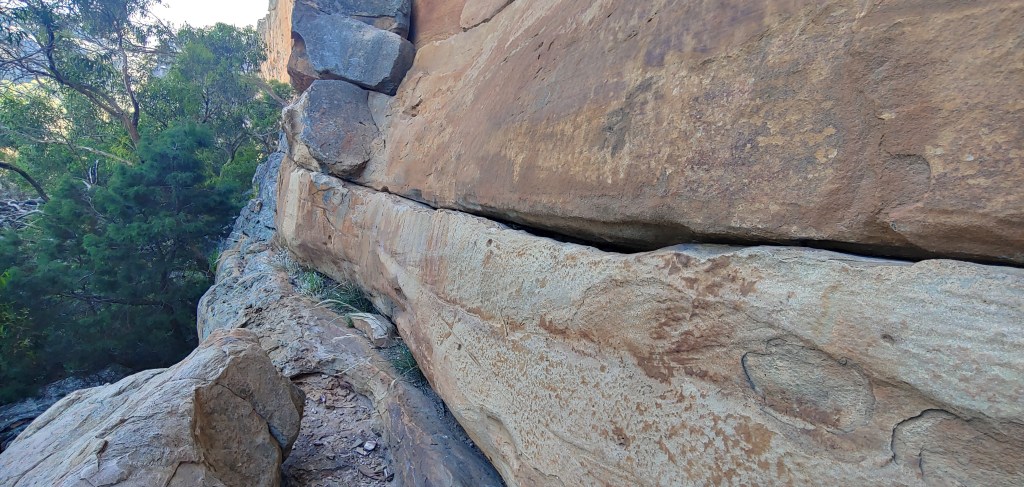
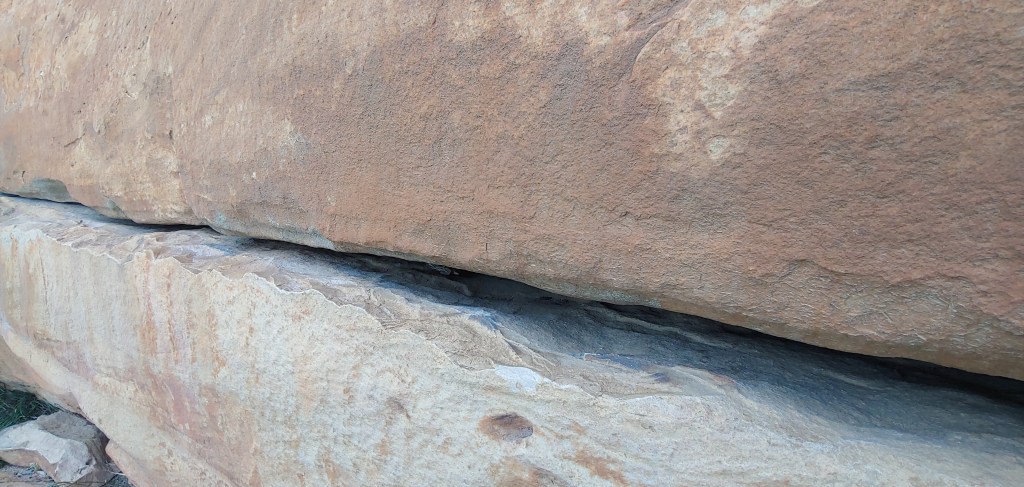
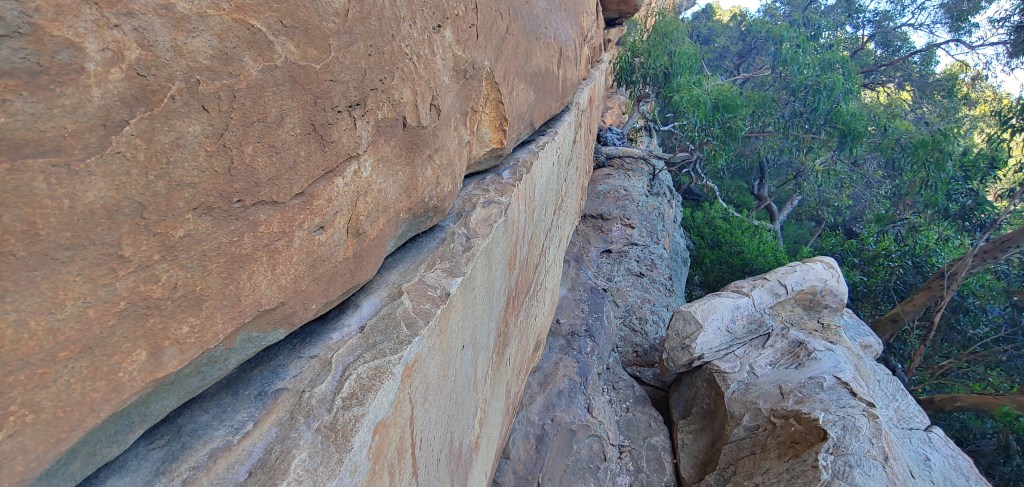
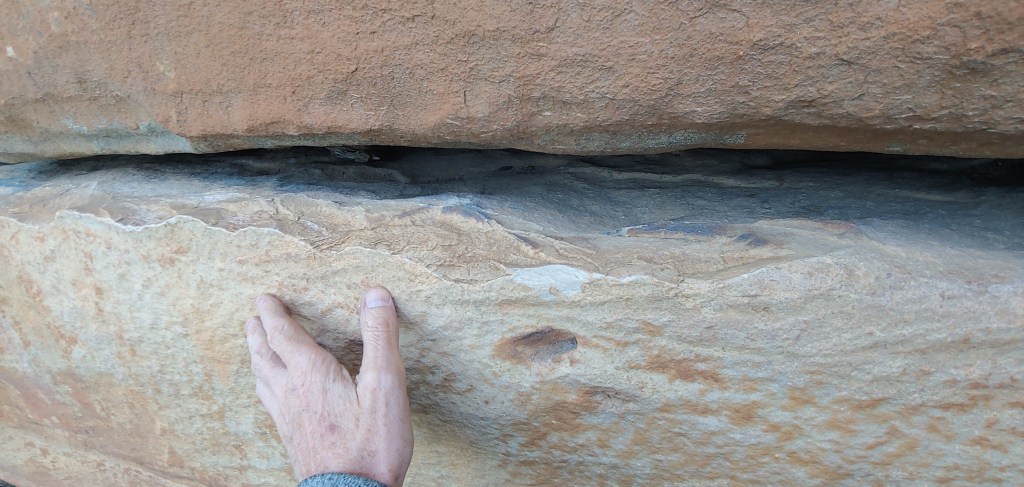
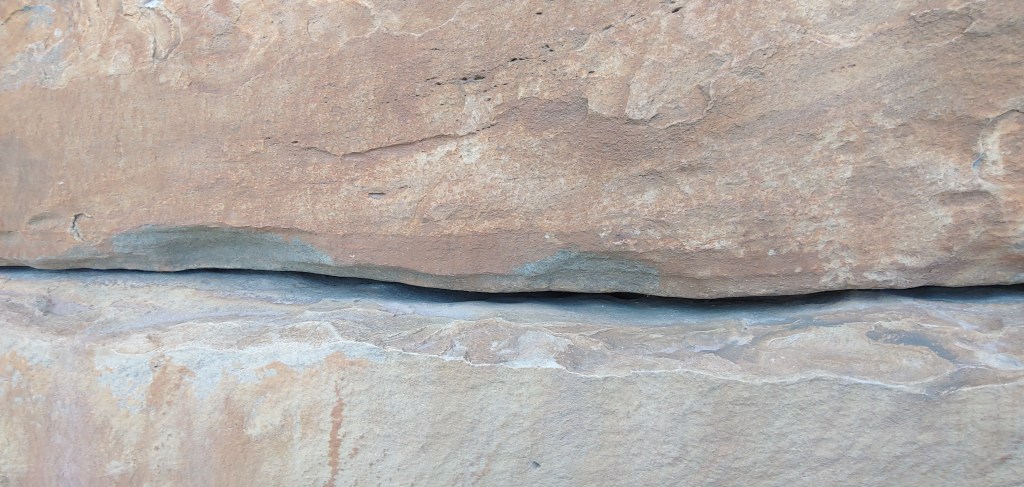
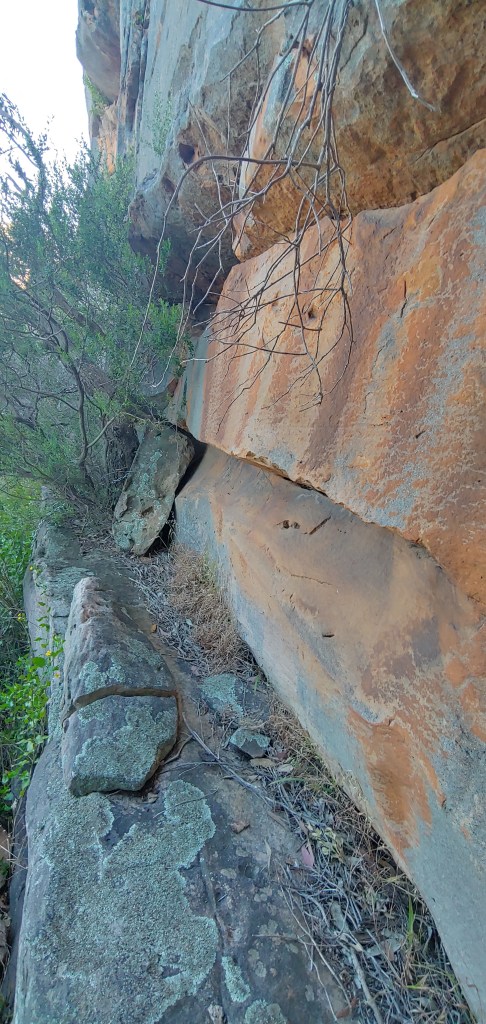
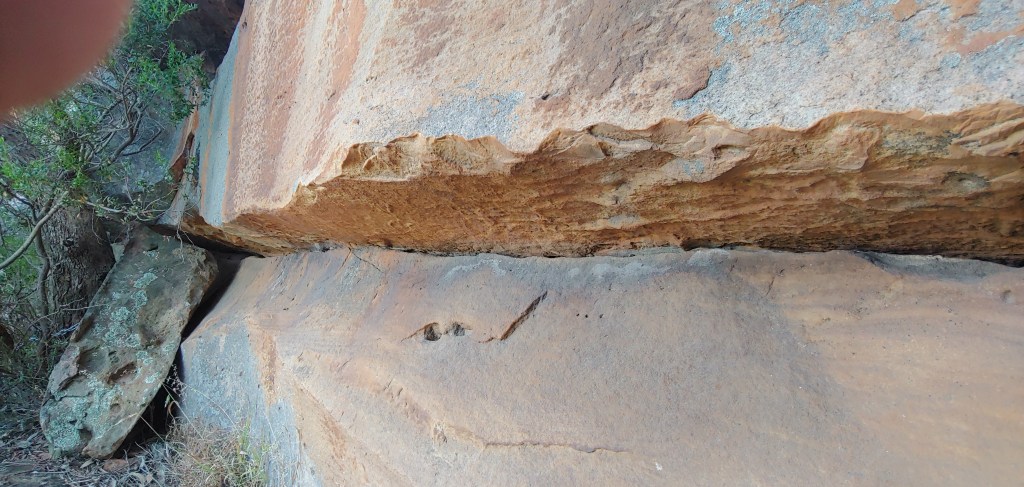
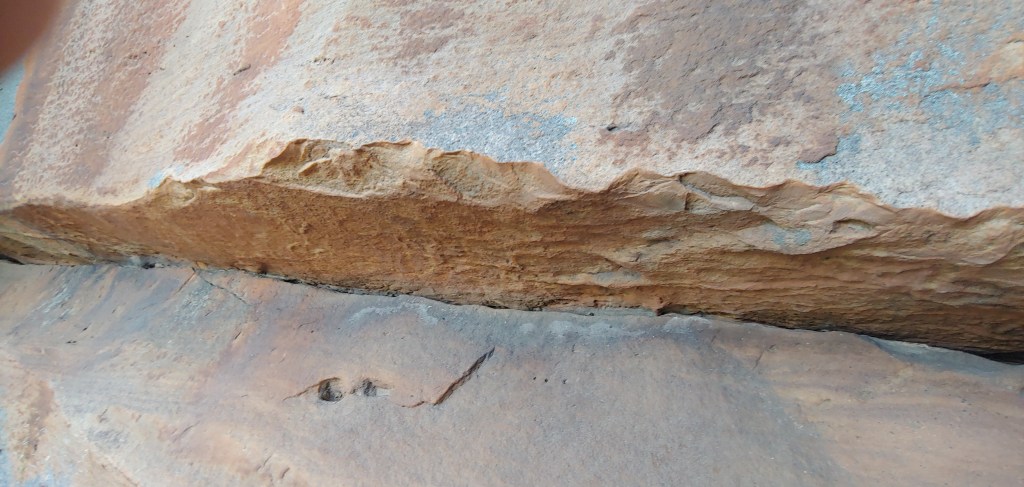
These photographs show the ‘quarrying’ rock scars below the route, Invisible Fist, believed to be the reason for the exclusion zone at Taipan Wall right side. The sharp edge of the rock shelf has been broken off in multiple locations to create small cutting tools, leaving a wavy, scalloped appearance to the edge of the rock. The resultant scars appear to be 5cm to 10cm in length. These markings have weathered over a long period of time to take up the same orange varnished colour as the surrounding rock.

What offence may be alleged on any climbing infringement notice?

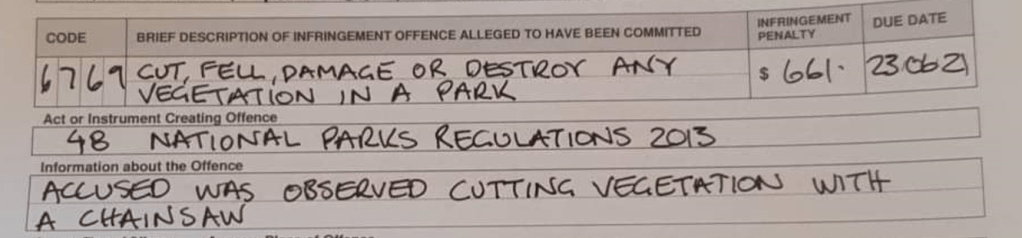
Infringement Notice Sample, showing an alleged offence (not climbing related)

To issue a ticket, the authorised officer (park ranger) must allege an “offence” under a specific clause of the relevant legal instrument, The National Parks Regulations 2013. These regulations are utilised to enforce The National Parks Act 1975.

We recently asked Parks Victoria this question in relation to the restricted sections of Taipan Wall:

Is there a feasible offence code that can be alleged by Parks Victoria or is damage to ancient rock chips the only option for prosecution? Since these highly durable rocks are largely impervious to harm, would you attempt an allegation of harm to intangible cultural values

ACAV 20 Jan 2023

Regardless of the inherent durability of quarried rock remnants, we fully support all initiatives to protect and revere archaeological findings by maintaining a safe and careful distance and fostering a culture of education and respect.

In their reply, Parks Victoria suggested three potential offences, only the first of which would appear feasible as an allegation against a rock climber:

  1. Fail to comply with the conditions of any relevant SET ASIDE INSTRUMENT put in place to protect environmental and cultural values in Parks.
  2. Interfere with rocks or similar natural objects, archaeological or historical remains and vegetation. (UNLIKELY – Climbing over rocks does not “interfere” with rocks any more than walking over rocks interferes with rocks. Walking over rocks and even over ancient quarry sites, occurs throughout the park.)
  3. Harm to Aboriginal cultural heritage set out in the Aboriginal Heritage Act 2006 (NOT APPLICABLE – Parks Victoria is not the regulator under this Act and hence cannot allege this offence. Other departments may seek to prosecute if harm was to be be established.)

We have not been made aware of any material harm to Grampians cultural heritage artifacts during more that 100 years of rock climbing activity.

It would appear that the only “offence” that could be alleged by Parks Victoria would be disobeying park rules, as defined within the management plan (a plan, not an Act). Such an allegation would be open to challenge in the Magistrates Court in the same way a person would challenge an inappropriate traffic infringement notice. Do the park rules have a legal and valid purpose if interference or harm does not occur and cannot be plausibly alleged?

Inappropriate use of the Set Aside legal instrument

ACAV has previously registered objection to the all-of-park set aside as being a park management blunt instrument that is non compliant with The National Parks Act 1975. The set aside legal instrument prompting offence allegation No.1 is clearly intended to protect defined locations within a park. Set aside administrative determinations must include a detailed map of the discrete area being set aside e.g. rock wallaby habitat, rare orchid zone or rock art site. It is disproportionate to set aside the whole park to exclude the public from everywhere by default.

Parks Victoria has appropriate authority to set aside and close an entire park under emergency circumstances e.g. bushfire. The misuse of this authority as an everyday basis for control is disproportionate, divisive and unmanageable.

We contend that a regulation made under The National Parks Act 1975 should not enable the land manager to deny public access as its default position. To do so is in clear contravention of the will of Parliament in passing the Act into law. The objects of the Act under s4(c) make this abundantly clear. It is the view of our legal advisors that all-of-the-park prohibitions or restrictions fail to satisfy the requirements of this overarching legislation.

4 Objects of Act
The objects of this Act
are—
(c) to make provision
in accordance with
the foregoing for the
use of parks by the
public for the
purposes of
enjoyment, recreation
or education and for
the encouragement
and control of that
use.

Note that the legality of any future climbing permit system would come under similar scrutiny as the Objects of the Act are being violated.

To further our query on this matter we have written to the Victorian Minster for The Environment as follows.

ACAV request for Ministerial review

We respectfully request a review by your department of this bullish and unworkable all-of-park approach for restricting public access to the entirety of a National Park.

ACAV 03 Feb 2023

Furthermore, the Minister has been made aware that “Rock climbing is successfully managed internationally, using collaborative management methods, as described within the Victorian Climbing Management Guidelines“.

We await the response of the Minister and we remain prepared to advise on any suitable challenge in the Magistrates Court over any inappropriate infringement notice that may be received by an ACAV member.

This all-of-park restriction methodology sets a worrying precedent for all public access to all Parks.

Opposition politicians and media representatives have been copied-in to the ACAV correspondence.

******************************************************

Please support the work that we do at ACAV:

Join as a member for $15

Ongoing feedback and assistance is always welcome: acav@climb.org.au
Quarrying Exclusion Zones – Taipan Wall

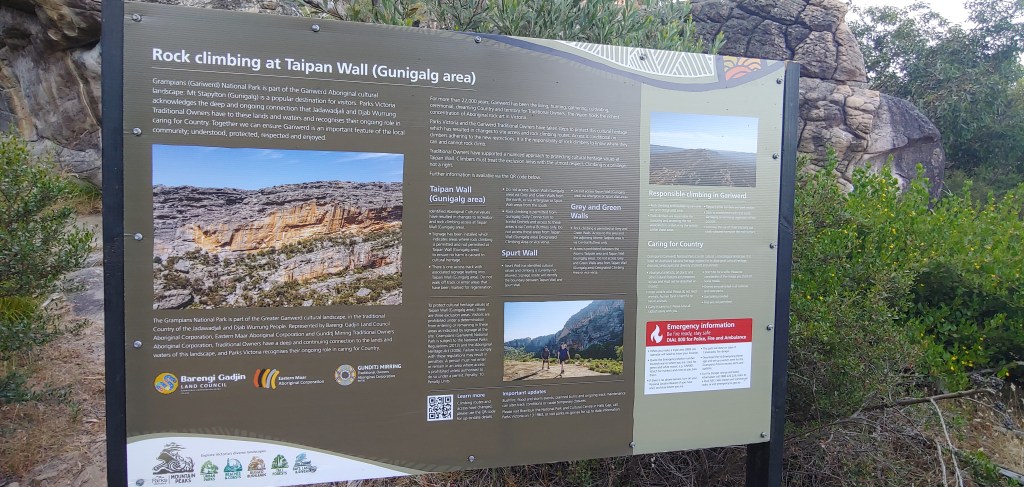
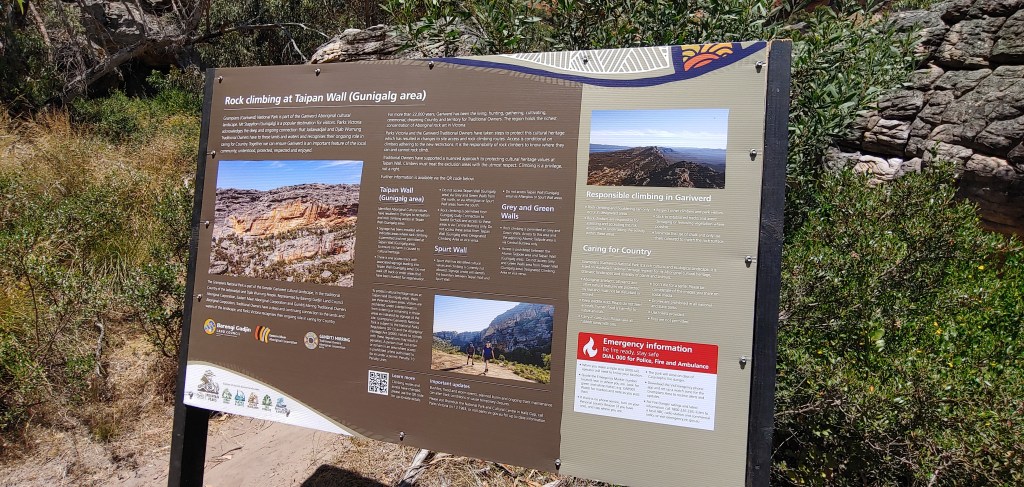
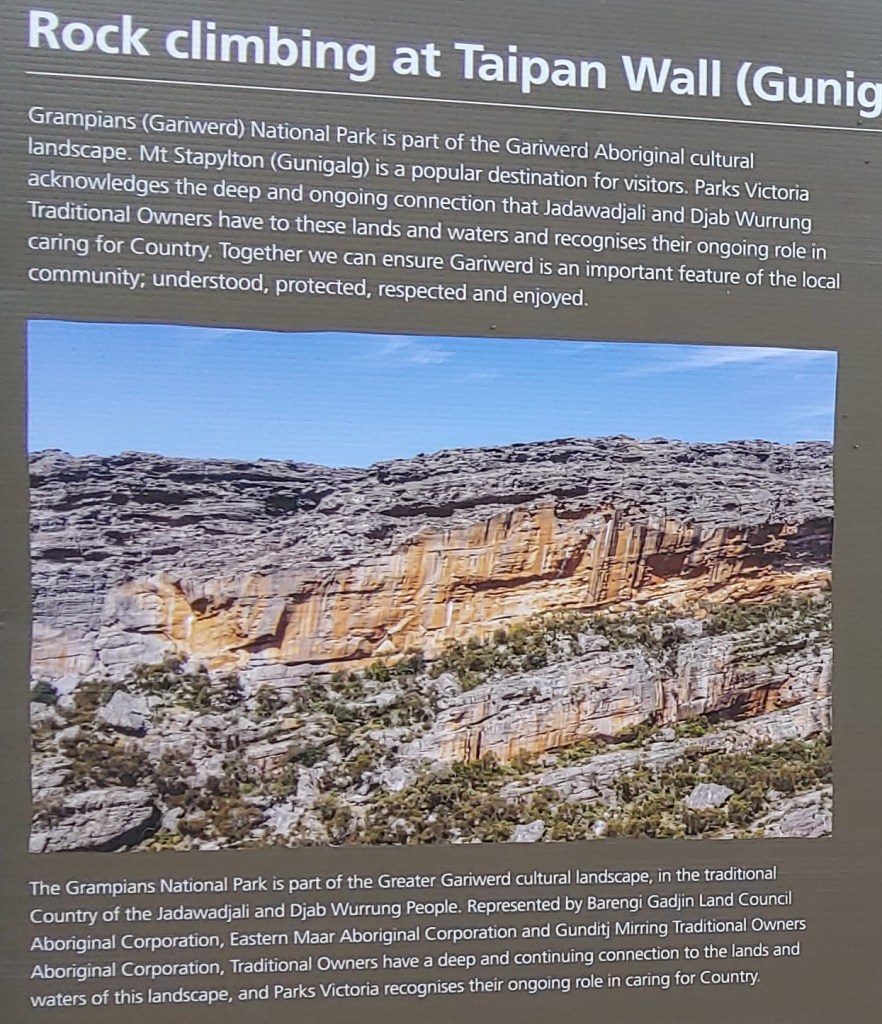
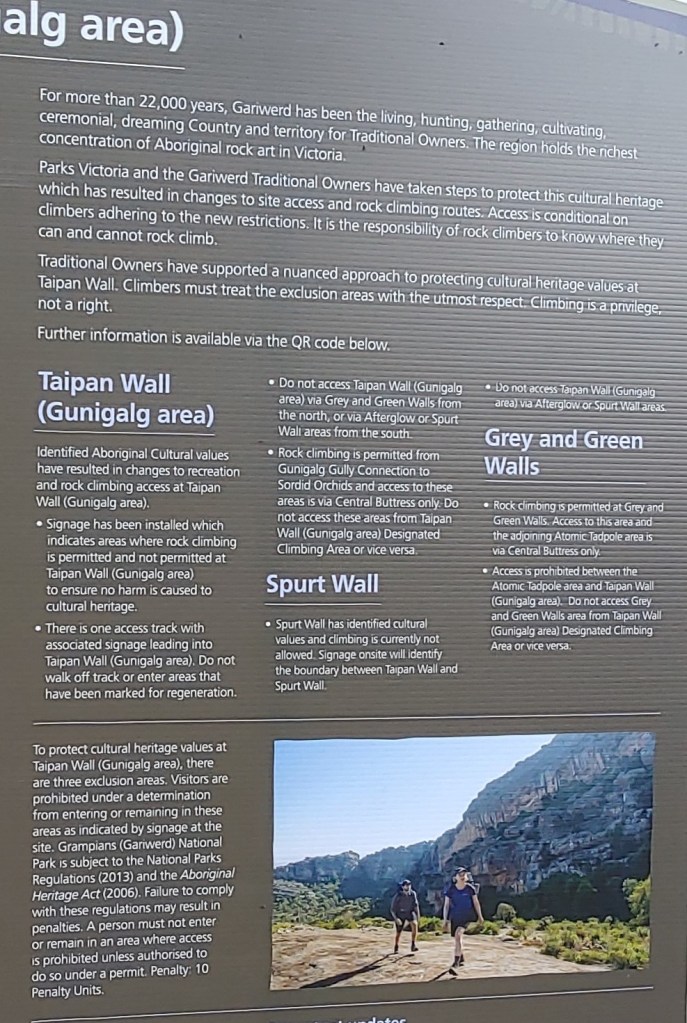
The right side of Taipan Wall has been designated a NO ENTRY zone to protect locations where ancient rock breakages have been found. This Taipan (South) exclusion zone includes Spurt Wall. Further smaller exclusion zones are also indicated at several locations along the base of the Taipan left side open section.

Taipan Wall Rock Climbing Information (link)

RIGHT SIDE NO ENTRY ZONE

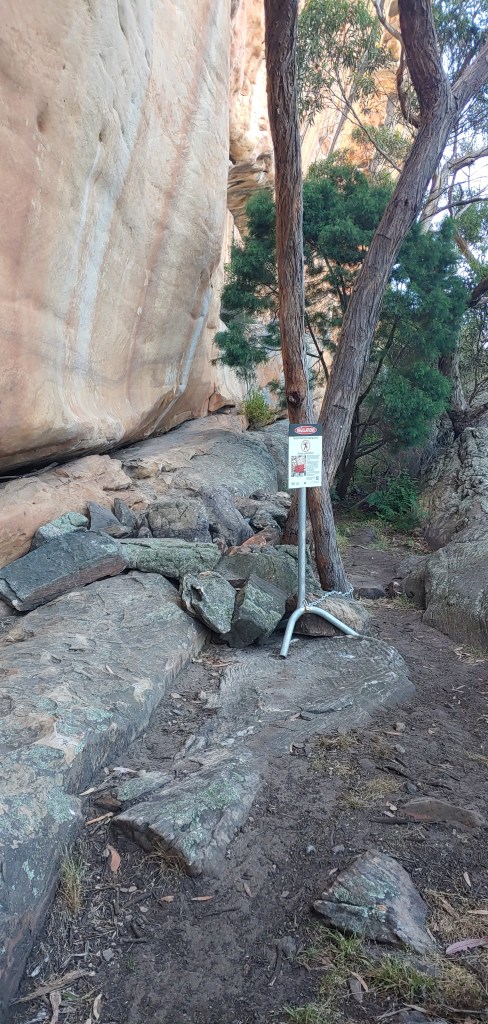
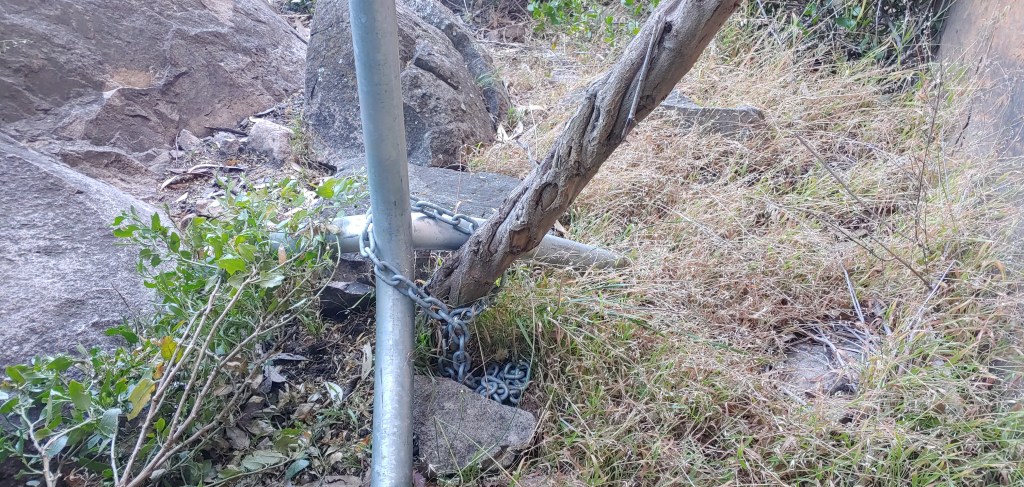
Below the route, Naja, a tripod sign has been placed on the footpath, discouraging access any further along the footpath to Taipan Wall right side and Spurt Wall

The following photographs show the ‘quarrying’ rock scars below the route, Invisible Fist, believed to be the reason for the exclusion zone at Taipan Wall right side:

SEVENTH BANANA NO ENTRY ZONE (within the open section of Taipan left side)

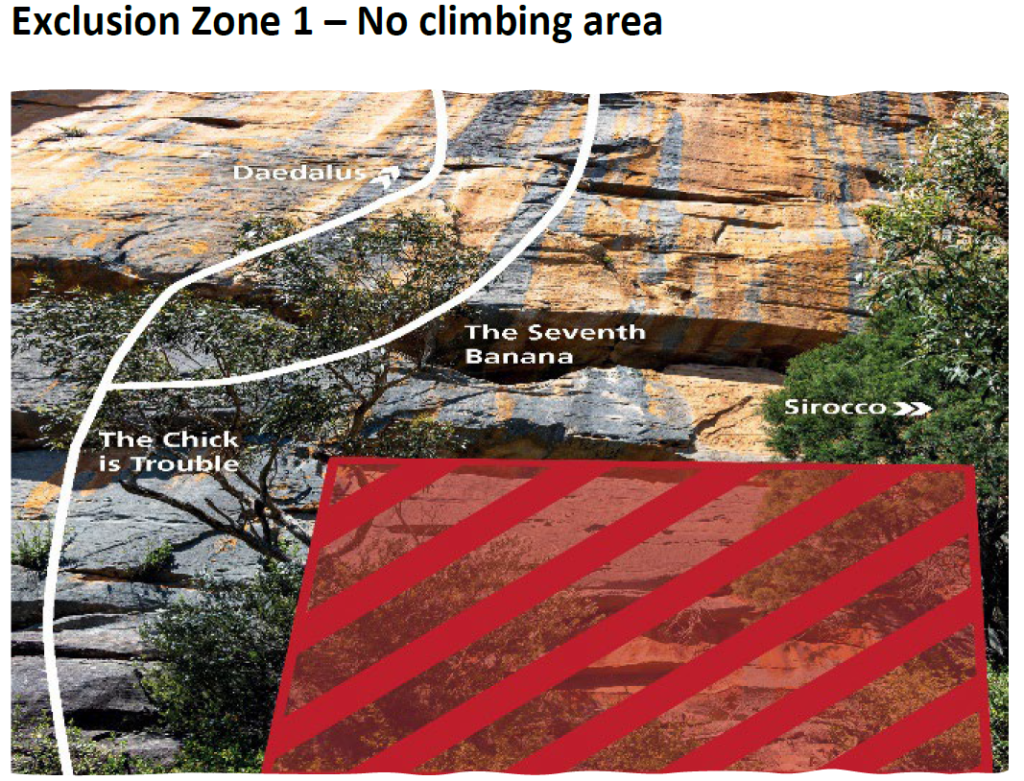
A tripod sign discourages access to rock breakages beneath the route, Seventh Banana. There are several similar small zones within the open section of Taipan Wall left side:

Detail of this zone from the Parks Victoria information sheet:

The following photographs show the ‘quarrying’ rock scars below the route, Seventh Banana, believed to be the reason for this exclusion zone :

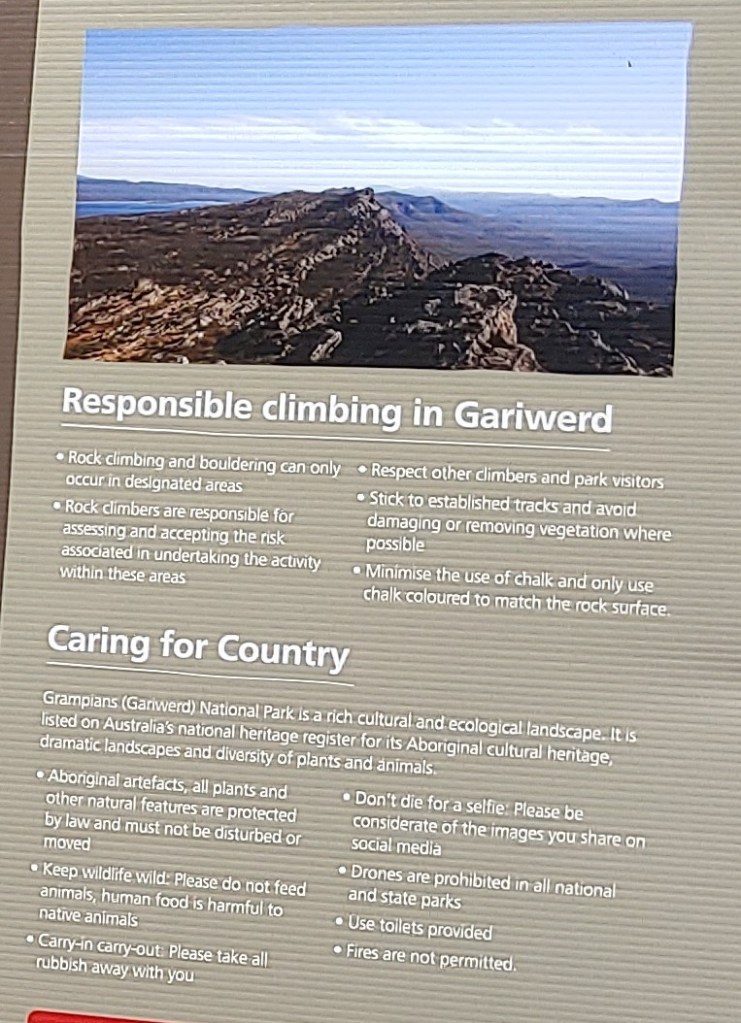
INFORMATION SIGNAGE FOR VISITORS

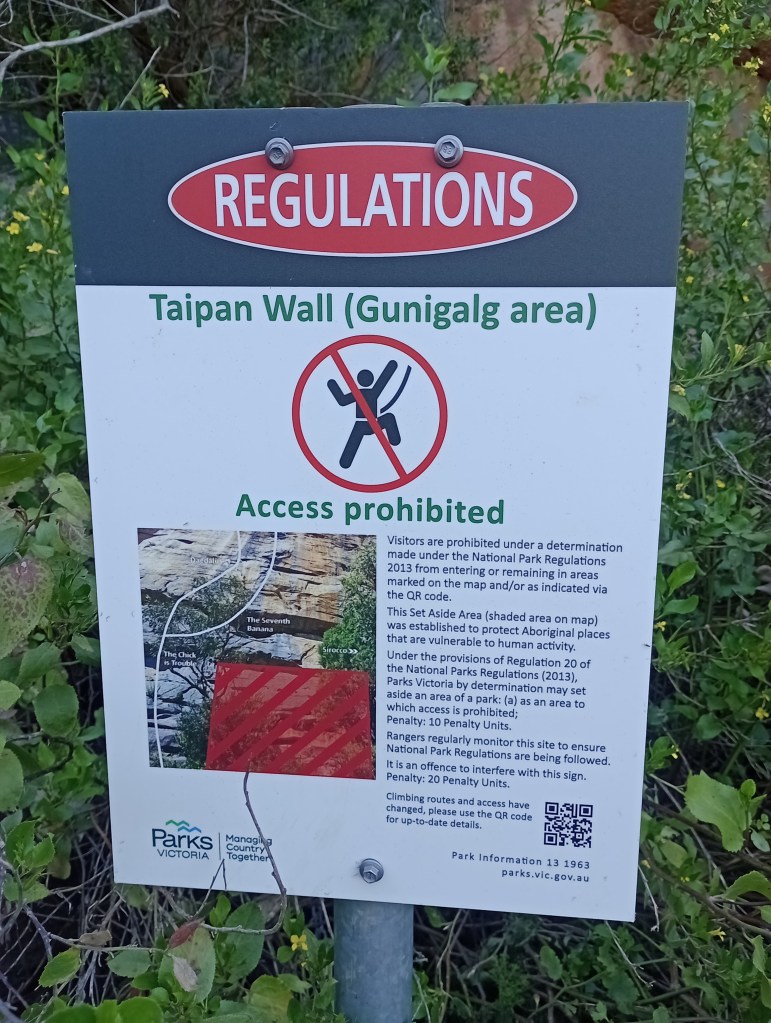
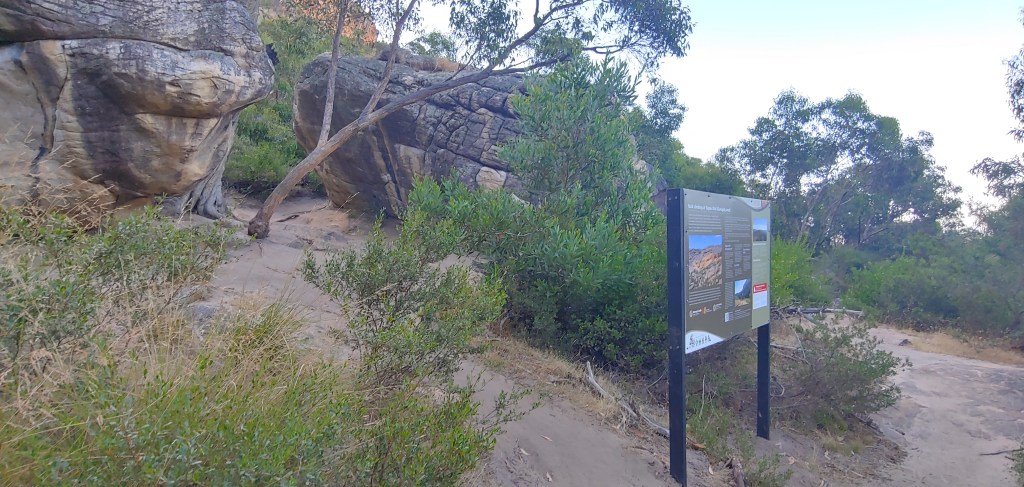
The following information signs have been installed at the Camp Sandy trail-head and at the Trackside boulders, beneath Taipan Wall:

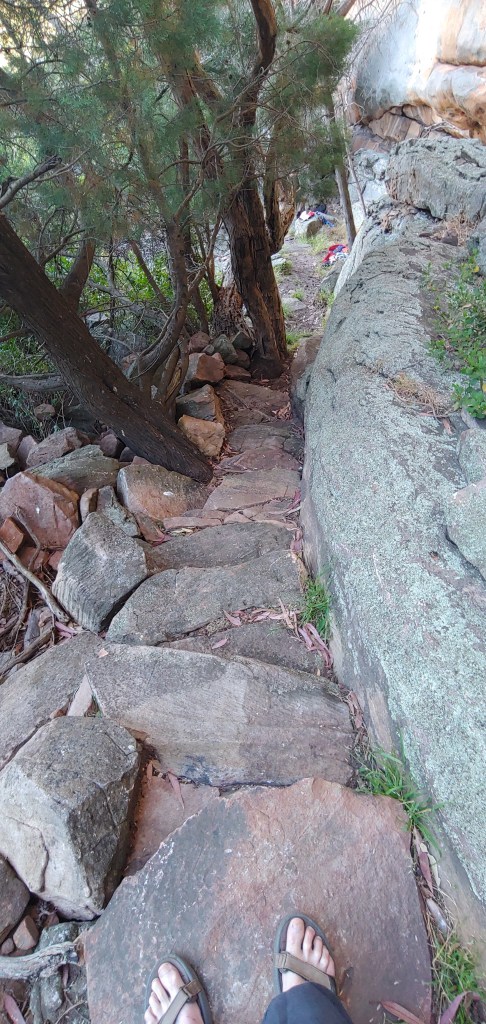
TRACK WORK

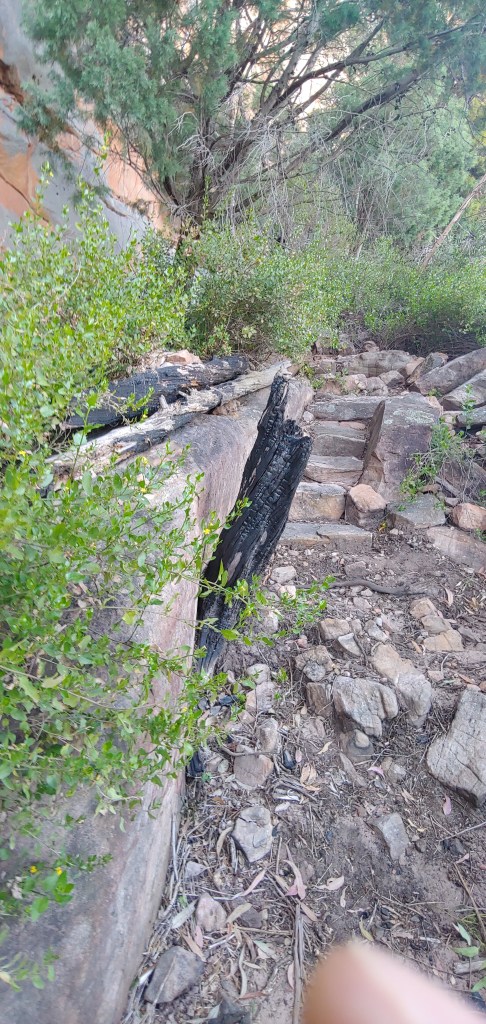
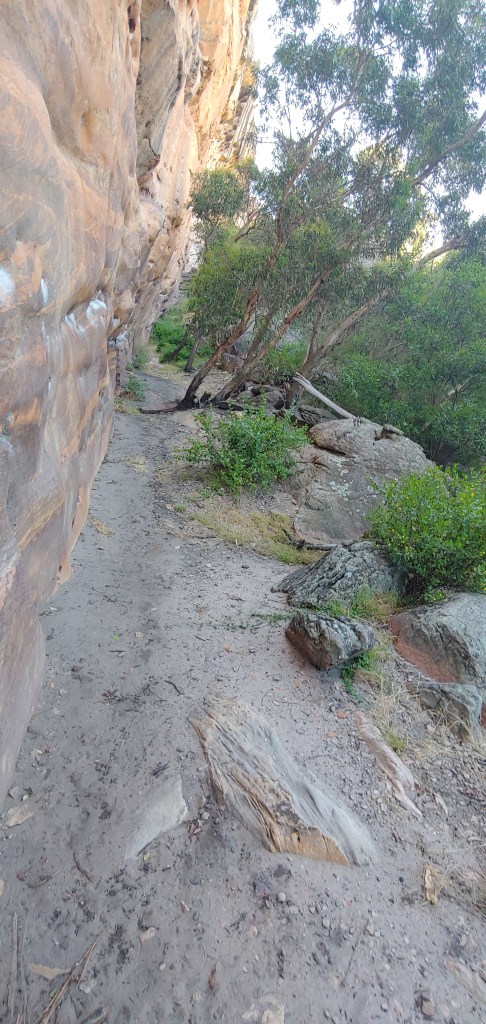
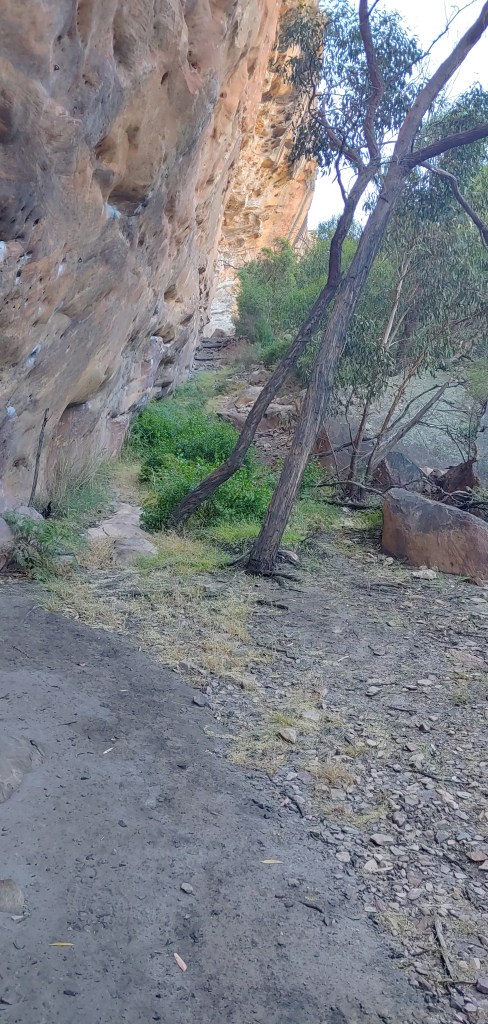
Minor track work has been completed by Parks Victoria, to facilitate these arrangements:

******************************************************

ACAV remains available to assist in the implementation of the Victorian Climbing Management Guidelines.

Please support the work that we do at ACAV:

Join as a member for $15

Ongoing feedback and assistance is always welcome: acav@climb.org.au